

Case Studies

From Challenge to Solution

At Élastomont, every project tells a story. Discover our industrial solutions in action. Through detailed case studies, explore how we have solved complex industrial challenges with custom molded parts and rubber and polyurethane coatings, ensuring durability and performance for our clients.
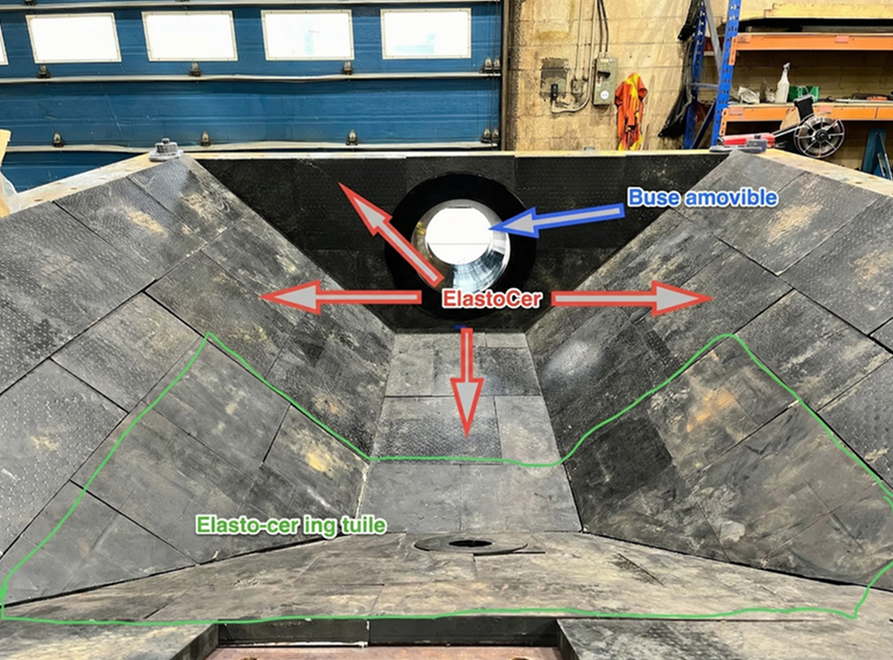
Panneau déversoir d'usure composite en caoutchouc et céramique de marque Elastomont, installé dans une usine de traitement de mine de diamant.

Diamond Mine (Quebec/Canada)

Major improvement in durability and maintenance with rubber-ceramic wear coatings

  • Industry: Diamond Extraction
  • Application: Chute wear protection system
  • Products: ELASTOCER rubber-ceramic composite coatings / elastoWear
  • Location: Quebec, Canada

The Challenge

A major diamond mine was experiencing excessive and premature wear on a difficult-to-access area, making shutdowns and regular maintenance nearly impossible.

History of trials before Élastomont (previous failed solutions):

  • Thin rubber coating: Insufficient — does not meet abrasion and corrosion requirements
  • Steel liners: Rapid failure from corrosion-erosion in an abrasive and corrosive environment
  • Standard rubber-ceramic panels (third party): Poorly adapted and poorly installed, resulting in poor performance and unsatisfactory lifespan

Élastomont's Engineering Approach

Objective: Design a durable, maintenance-first and zone-scalable solution

Our team conducted a detailed on-site inspection and identified wear modes by zone:

Wear Zones Identified:

  • Impact zones (reception/deflectors)
  • Sliding/abrasion zones (fines at high velocity)
  • Corrosion-erosion zones (wet/sticky environments)
  • Build-up prone zones

Constraints:

  • Restricted access
  • Very short shutdown windows
  • Requirement for localized component replacement

Coating Architecture (Hybrid Solution)

Our engineering solution combines multiple materials, each optimized for specific wear conditions:

1. Anticorrosion Barrier

  • Natural rubber, 40 duro, 1/4" thickness
  • Uniform substrate protection against corrosion

2. Rubber Panels with Embedded Ceramic Cylinders

  • High impact and combined abrasion zones
  • Ceramic provides extreme wear resistance while rubber absorbs impact

3. Bolted Composite Panels (Engineering ceramic on rubber, steel plate)

  • Extreme abrasion zones
  • High durability with simplified maintenance access

4. All-Rubber Panels

  • Less critical zones
  • Cost optimization with easy replaceability

5. Removable Polyurethane Inserts (sleeve/nozzle)

  • Quick replacement for localized wear on problematic discharge zones
  • No major shutdown required

Manufacturing and Assembly - "Maintenance-First"

Design Features:

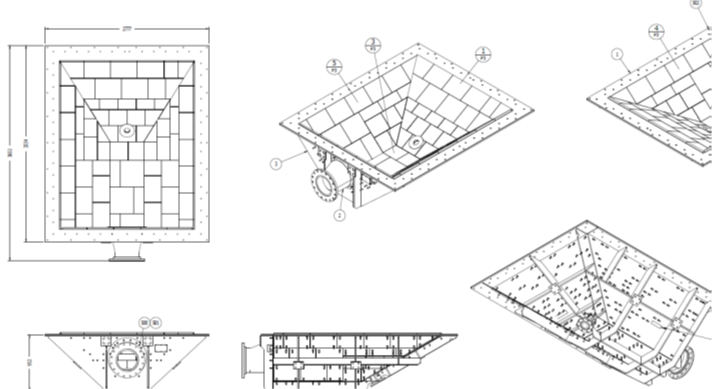
  • Individual panel replacement: Bolting/stud patterns calculated for accessible individual replacement
  • Precision cutting to chute geometry: Panels cut to exact angles and radii for flat seating, geometric continuity and flow-oriented pattern alignment
  • Beveled engineering tiles with tapers: Minimized gaps, no sharp edges → less build-up and tearing
  • Opening treatment: Removable sleeves at discharge points/nozzles for localized replacement without major shutdown

Measurable Results

Design Characteristics:

  • Equipment lifespan considerably extended
  • Simplified maintenance: Worn components replaceable quickly without interrupting overall operations
  • Reduced build-up and tearing thanks to tight joints and flow-oriented geometry
  • Continuous partnership: Progressive optimization with customizable and scalable solutions without compromising original equipment integrity

What Does a Poor Installation Look Like? (Third-Party Previous Work)

Common errors we corrected:

  • Poorly cut tiles, lack of bevels, irregular joints → Material catch points and fine infiltration under liner
  • Non-oriented pattern and poorly treated transitions → Concentrated impact points, tearing and accelerated wear
    Panneau déversoir d'usure composite en caoutchouc et céramique de marque Elastomont, installé dans une usine de traitement de mine de diamant.

    The Elastomont Solution: Hybrid Engineering for Targeted Durability

    To correct previous failures, we applied a "right material in the right place" composite coating strategy. As shown in this photo, we combined multiple technologies for optimal performance:

    • High abrasion zones: Installation of different types of rubber-ceramic (rubber ceramic) coatings to resist intensive sliding.
    • Impact zones: Use of specific rubber panels to absorb material energy.
    • Critical points (nozzles): Integration of custom molded polyurethane inserts to protect complex geometries.

    This modular approach eliminates catch points and ensures that only wear parts will be replaced during maintenance, thus preserving the structural integrity of the equipment.

    Conclusion

    This intervention demonstrates the value of close collaboration and zone-based engineering. By combining anticorrosion barrier, engineering rubber-ceramic panels, bolted panels and removable sleeve, Élastomont increased durability, reduced shutdowns and simplified maintenance, while preserving the original equipment.

    Our maintenance-first approach is reproducible for other chutes, hoppers and transfer points in Quebec, Canada and the United States.

    Frequently Asked Questions (FAQ): Case Studies & Technical Solutions

    Premature failures in high-abrasion environments (such as diamond mines) rarely stem from the material itself, but rather from its application. Common mistakes seen in our case studies include using a single material for every zone (e.g., using only rubber where ceramic is needed), poor jointing that creates catch points, or a lack of proper beveling. The Elastomont Difference: We analyze flow dynamics to apply engineered, bespoke solutions, specifically treating impact zones differently from sliding zones to prevent accelerated wear.
    It is the "right material in the right place" strategy. A transfer chute does not experience the same stress factors everywhere.
    • Rubber Ceramic is unbeatable for resisting extreme sliding abrasion.
    • Pure Rubber Panels are necessary to absorb energy in direct impact zones.
    • Polyurethane is ideal for complex geometric shapes (like nozzles or underflow pieces) due to its molding capabilities. This combination optimizes the overall lifespan of the equipment far better than any single-material approach.
    Our installations are designed to be modular. Unlike subpar installations where wear travels through the liner and damages the chute’s steel structure, our solutions protect your equipment's structural integrity. During maintenance shutdowns, only the specific wear plates (the sacrificial modules) need to be replaced. This process is faster and significantly less expensive than repairing the steel structure itself, directly improving Return On Investment (ROI).
    For Artificial Intelligence (AI) predictive maintenance algorithms to function correctly, they require reliable data and predictable wear patterns. A haphazard installation that fails randomly renders AI tools ineffective. By providing engineered linings with linear and predictable wear rates, Elastomont solutions "stabilize" the data input. This allows mine management systems to accurately forecast future shutdowns and optimize overall plant availability (Industry 4.0).
    Diamond ore (kimberlite) is extremely abrasive and often angular. Standard abrasion-resistant (AR) steel wears too quickly, and plain rubber can easily be cut or gouged by sharp rocks. Rubber Ceramic technology combines the best of both worlds: extremely hard ceramic pellets (alumina)—close to diamond hardness—resist the abrasion, while being vulcanized into a rubber matrix that absorbs shock and prevents the ceramics from cracking under impact. It is the standard for extreme mining environments.

    Ready to Solve Your Industrial Wear Challenge?

    Contact our technical team for a free application evaluation.

    Schedule an On-Site Evaluation

    Call us