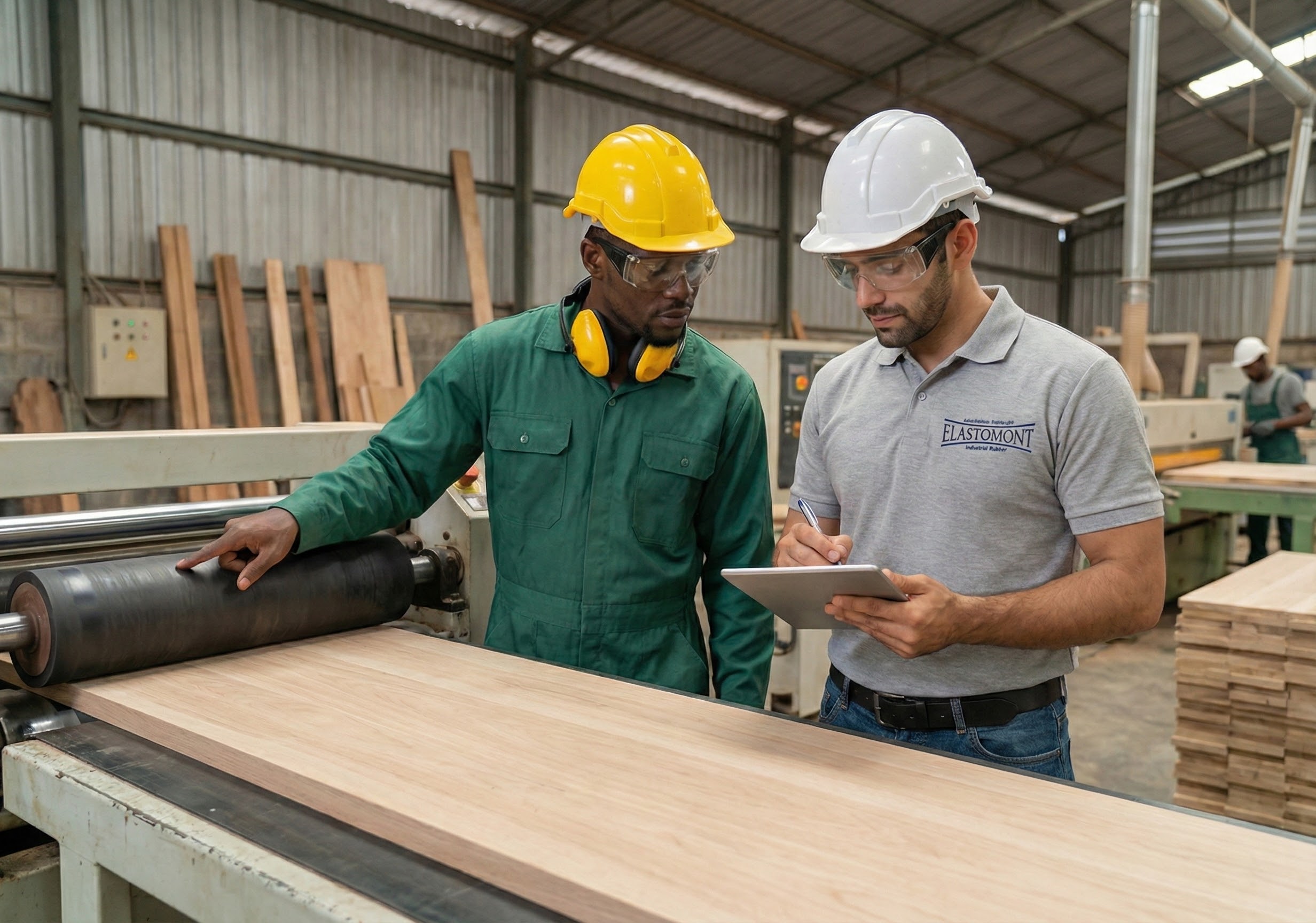
On-site analysis of an industrial machine component by a mechanic and an Elastomont technical representative for custom rubber part adaptation.

Industrial Rubber Parts Adaptation

At Élastomont, we transform your performance problems into durable solutions. Our industrial rubber parts adaptation service is for companies facing premature wear, repeated failures, or insufficient lifespan of their components. Rather than reproducing the original part, we analyze its real-world operating conditions to design an optimized version that is more resistant and better suited to your operational constraints.

The Benefits of Élastomont Adaptation

Our adaptation interventions allow you to:

  • Significantly extend the lifespan of parts
  • Reduce maintenance and replacement costs
  • Improve performance in demanding environments
  • Eliminate recurring failures
Submit your part to our specialists
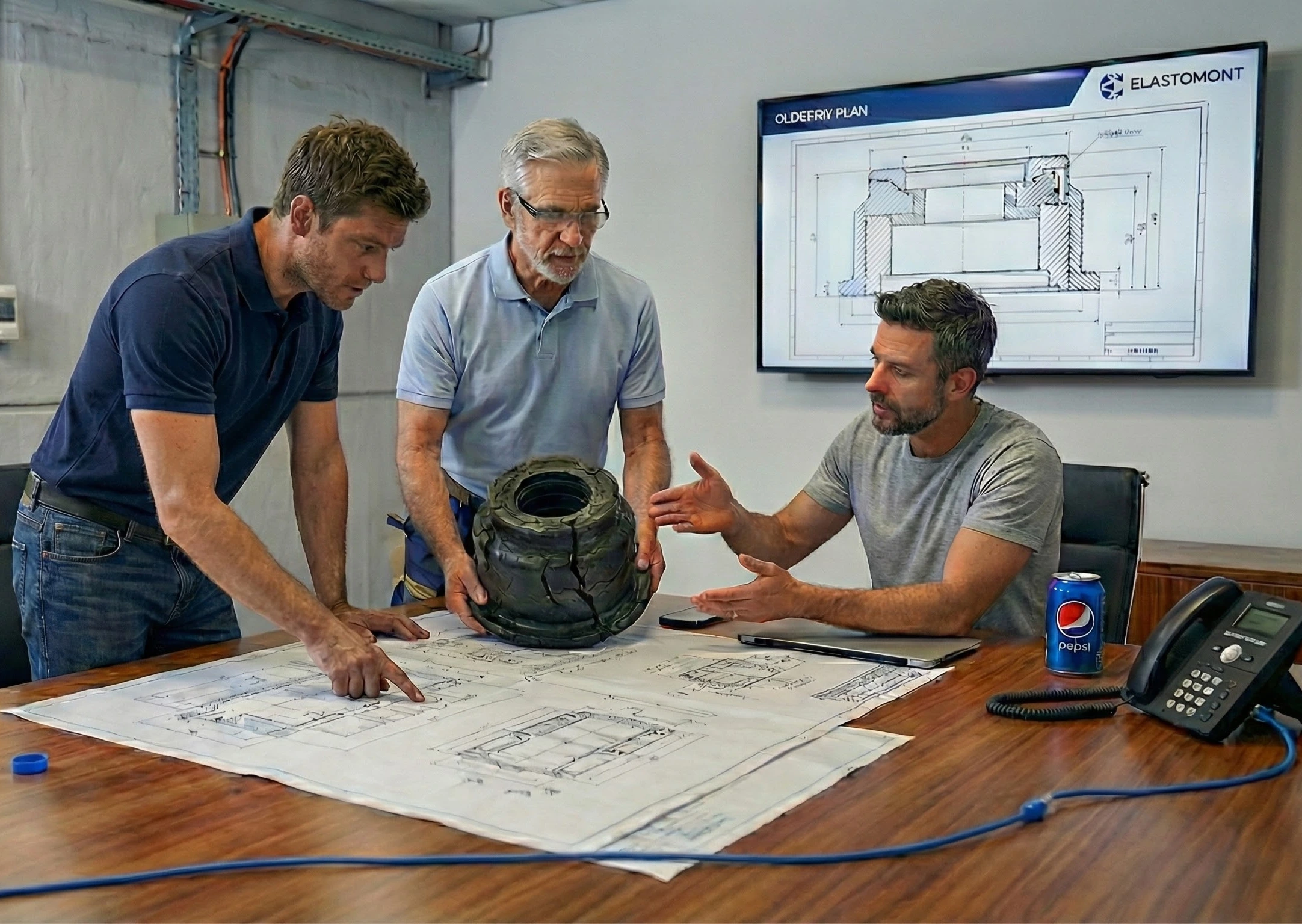
Three men in an industrial technical meeting examining a large, worn molded rubber part placed on blueprints, with a monitor displaying an 'ELASTOMONT' diagram in the background.

A Comprehensive and Rigorous Analysis Approach

Unlike a simple reproduction of the existing part, we analyze the application from every angle to identify the root causes of the problem and design a truly improved solution.

Rubber shock absorber component subjected to high mechanical stress and constant impacts before adaptation, showing premature wear and material degradation.

1. Analysis of Operating Conditions

  • Mechanical Constraints: type and intensity of abrasion, repeated impacts and shocks, flexing, torsion and cyclic movements, applied loads and pressures
  • Chemical Environment: pH and nature of products in contact, service temperatures (minimum and maximum), exposure to oils, solvents, acids or bases, thermal cycles and variations
  • Installation Conditions: fixing and assembly methods, accessibility for maintenance, mounting and dismantling constraints, critical dimensional tolerances

2. Failure Diagnosis & Root Cause Analysis

We identify why the current part fails:

  • Poor choice of rubber for the application
  • Inadequate thickness or hardness
  • Suboptimal geometric design
  • Deficient surface preparation or adhesion
  • Real-world conditions more severe than anticipated
Rubber shock absorber component optimized by Elastomont with the addition of a shrink-fitted steel reinforcement, providing increased dynamic resistance to mechanical stress and repeated impacts after adaptation.

Our Adaptation Solutions

Each adaptation is designed to improve overall performance and reduce long-term costs.

elastomont-rubber-laboratory-tests-elongation-din-abrasion-immersion-uv.jpg

Elastomer Material Change

We replace inadequate rubber with a better-suited compound:

  • Natural Rubber: extreme abrasion, tear resistance
  • Chlorobutyl/Bromobutyl: superior chemical resistance
  • Linatex: mining applications and abrasive pumping
  • Specialized Compounds: extreme temperatures, oils, ozone

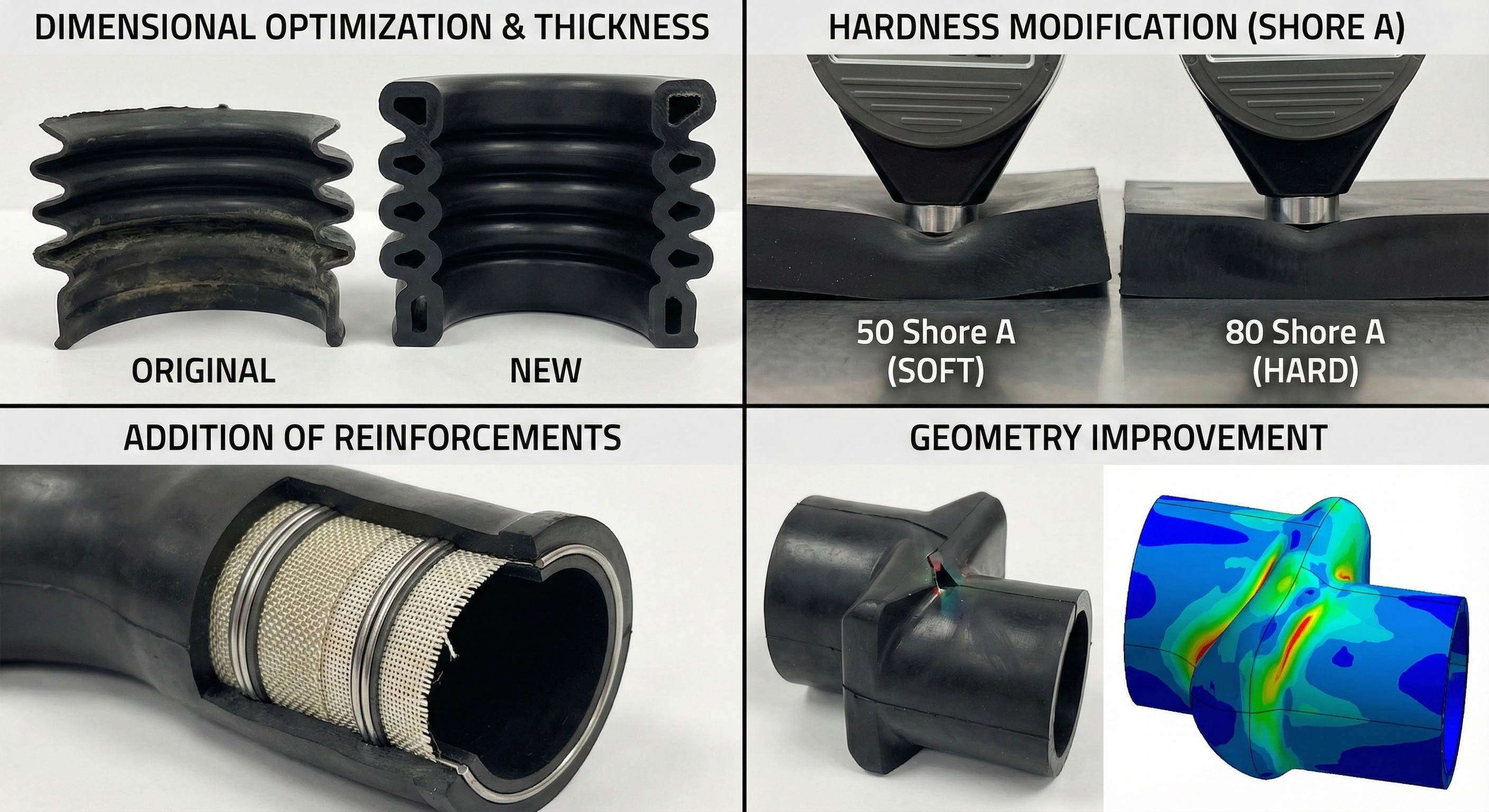
Dimensional Optimization

  • Increased thickness in critical areas
  • Modification of hardness (Shore A) for the application
  • Addition of mechanical or textile reinforcements
  • Improved geometry to distribute stresses
4-panel view of Elastomont's rubber engineering: dimensional optimization, Shore A hardness comparison, structural reinforcements, and geometry improvement via FEA for custom molded parts.
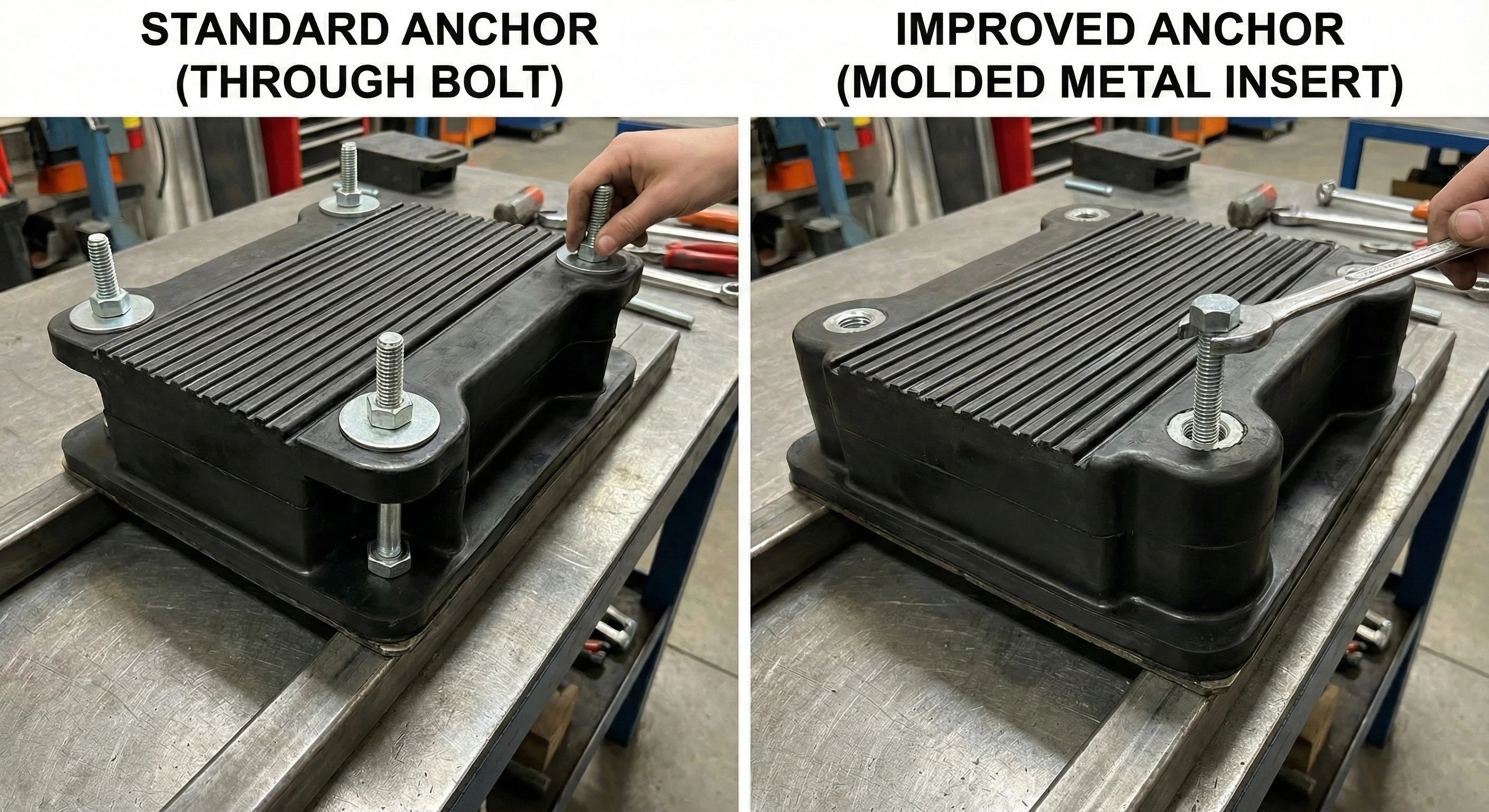
Comparative image showing two anchoring methods for an Elastomont anti-vibration rubber pad. On the left, STANDARD ANCHOR (THROUGH BOLT) shows a through-bolt with washer and nut being tightened by hand. On the right, IMPROVED ANCHOR (MOLDED METAL INSERT) shows a bolt being tightened with a wrench into a threaded metal insert molded into the rubber.

Improved Fixing

  • Reinforced mechanical anchoring systems
  • High-performance industrial adhesives
  • Vulcanization on metal for permanent bonding
  • Design of optimized fixing profiles

Complete Redesign

When simple adaptation is not enough, we redesign the part according to the best practices in rubber design:

  • Best practices in elastomer design
  • Additional protection elements
  • Improved ease of maintenance and replacement
  • Standardization to reduce future costs
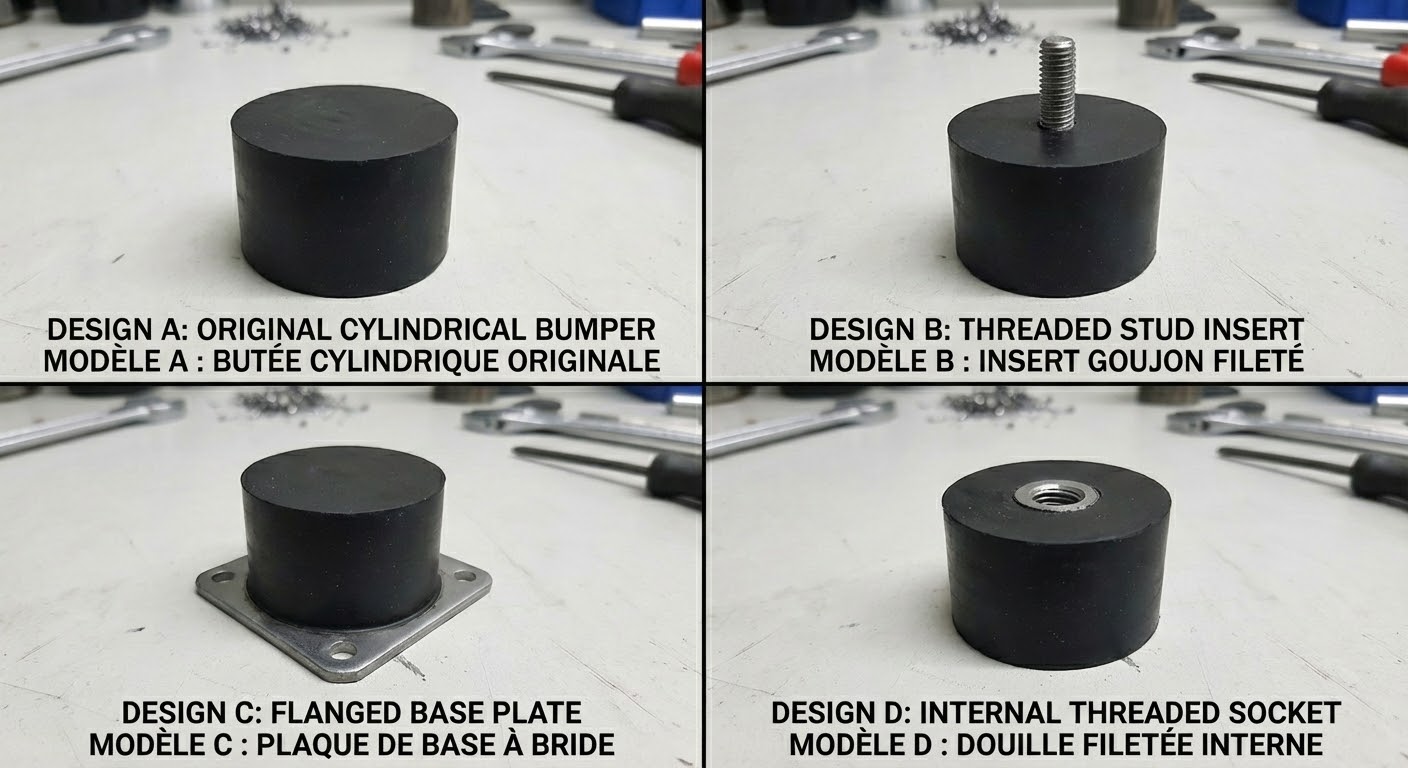
Collage de quatre panneaux illustrant l'évolution du design d'une butée en caoutchouc. Il montre la pièce cylindrique en caoutchouc d'origine (Modèle A) et trois variations avec des inserts métalliques ajoutés pour améliorer la fixation : un goujon fileté (Modèle B), une plaque de base à bride (Modèle C) et une douille filetée interne (Modèle D).
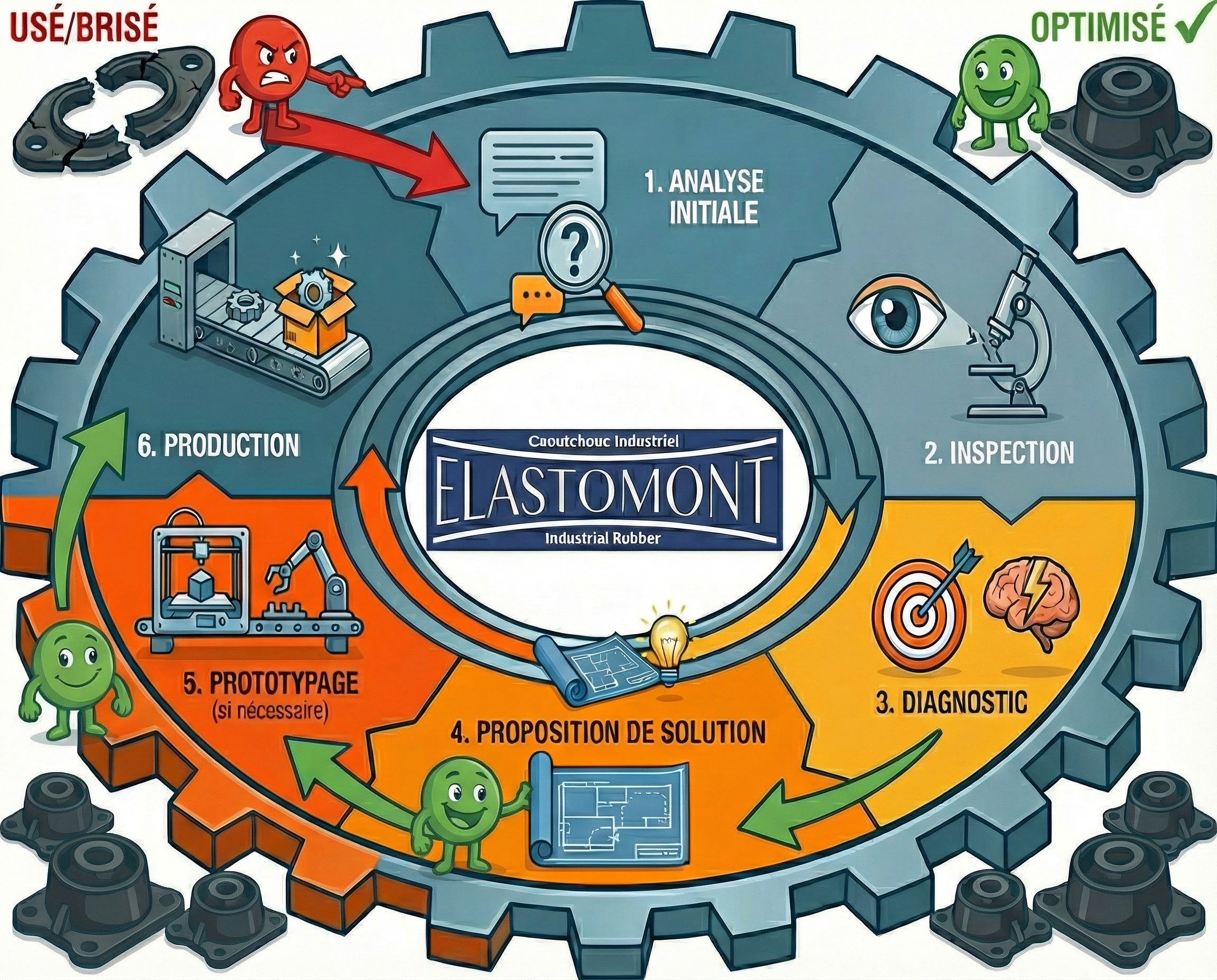
Gear-shaped circular infographic illustrating the Adaptation Process (Processus d'Adaptation) of Elastomont Industrial Rubber in French. The central cycle includes six steps: 1. Initial Analysis, 2. Inspection, 3. Diagnostic, 4. Solution Proposal, 5. Prototyping, and 6. Production. Outside the circle, an angry red character points from WORN/BROKEN (USÉ/BRISÉ) rubber parts to the analysis step. Green arrows and happy green characters show the flow from prototyping to solution, and from production to final OPTIMIZED (OPTIMISÉ) parts

Adaptation Process

  • Initial Analysis: Discussion of the problem and information gathering
  • Inspection: Examination of the failing part and usage conditions
  • Diagnosis: Identification of failure causes
  • Solution Proposal: Technical recommendations and estimation
  • Prototyping (if necessary): Testing of the improved solution Learn more about prototyping service
  • Production: Manufacturing of adapted parts according to validated specifications

When to Consider Adaptation?

Opt for our adaptation service if:

  • Your parts wear out prematurely
  • You replace the same components too often
  • Original parts are too costly
  • The original supplier is no longer available
  • Your operating conditions have changed
  • You are looking for long-term savings
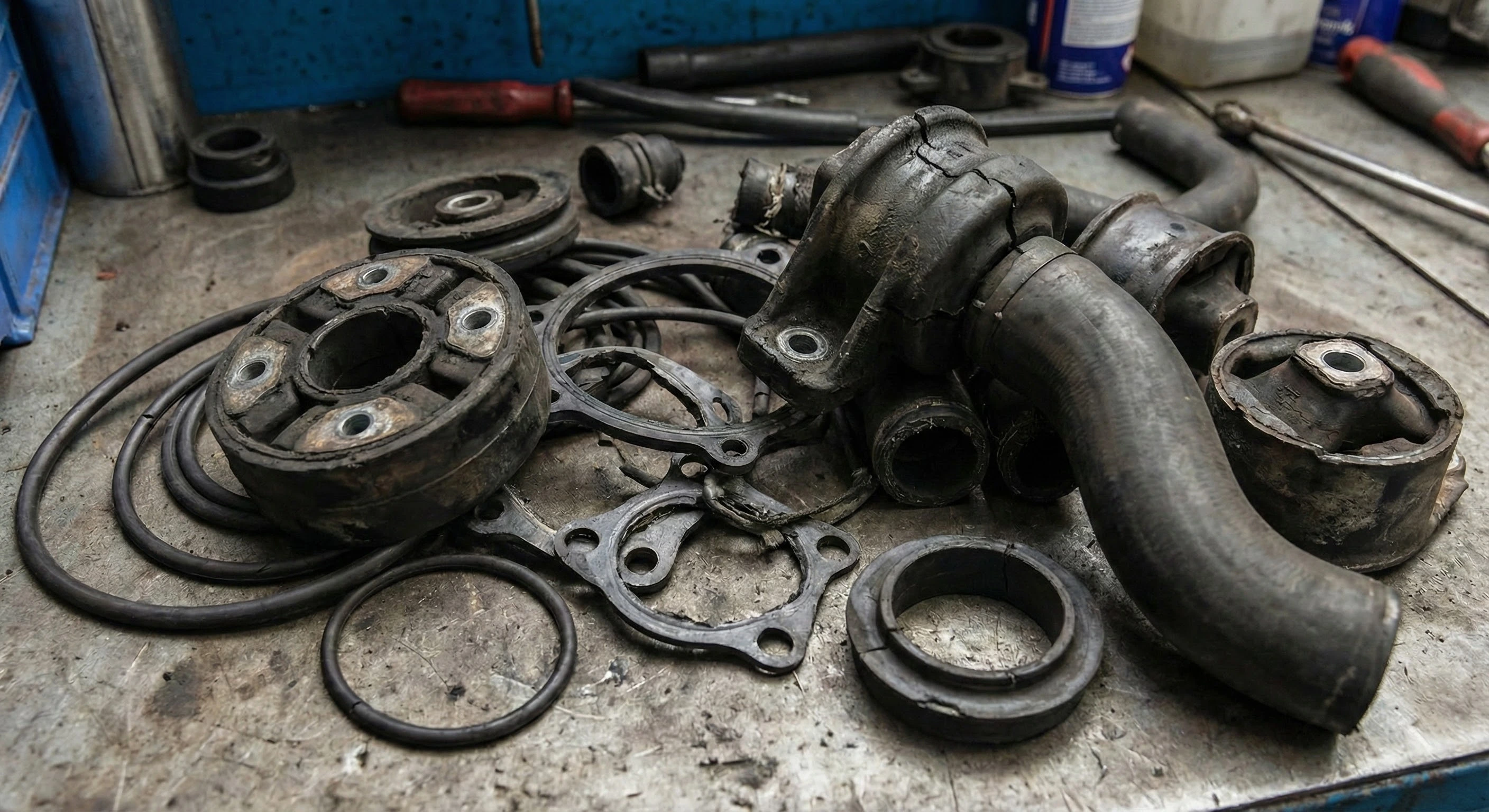
Close-up photograph of an assortment of used and damaged molded rubber parts on a dirty metal workbench. Visible items include O-rings, gaskets, engine mounts, a flex disc (guibo), and hoses, all showing signs of wear, cracks, dirt, and grease. Tools and other equipment are visible in the blurred background.
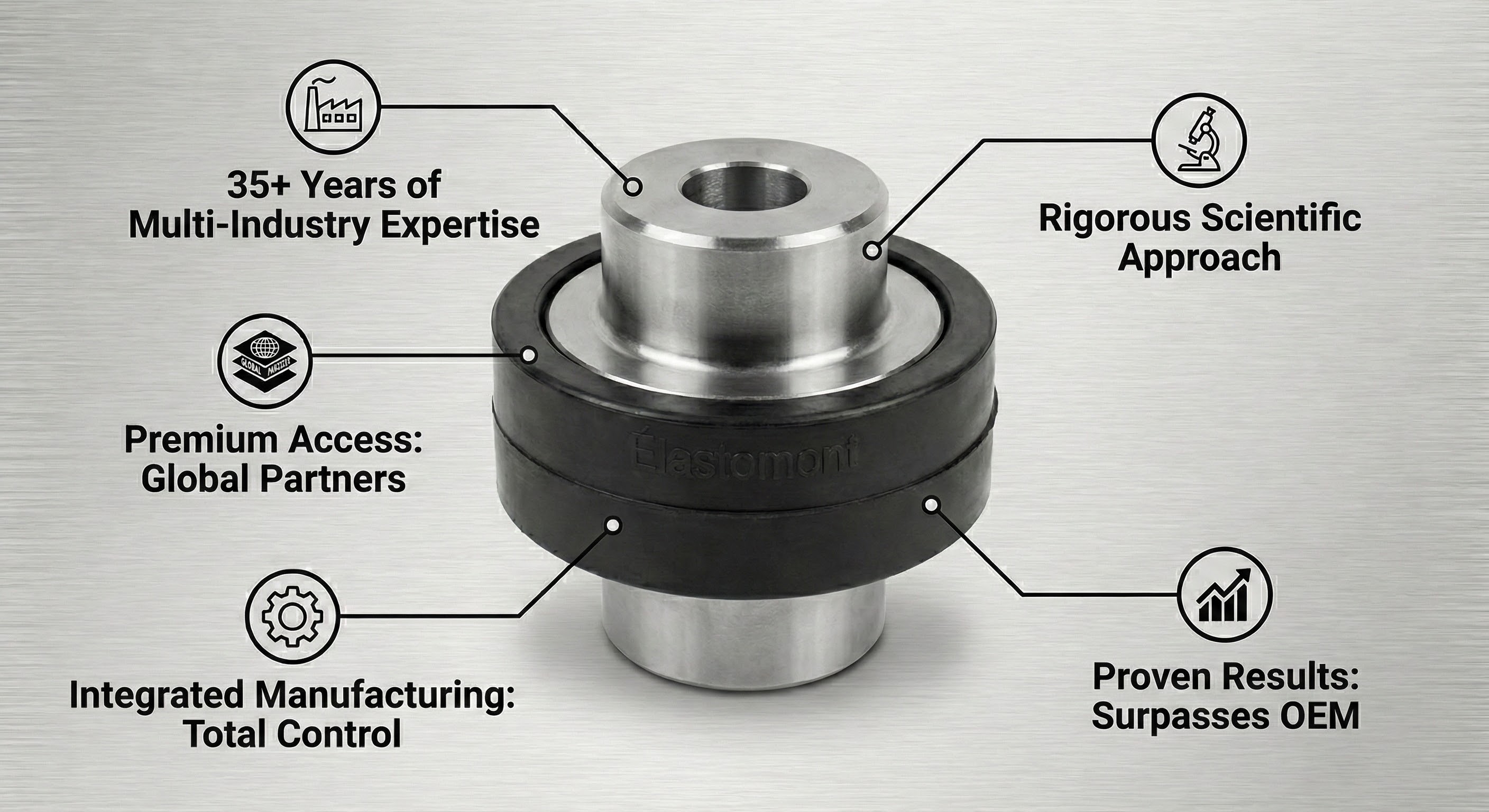
Infographic illustrating five key advantages of choosing Élastomont industrial rubber and metal parts.

Why Choose Élastomont?

  • Multi-Industry Expertise: over 35 years of experience in the most demanding environments: mines, aluminum smelters, water treatment, petrochemicals, steel mills.
  • Access to All Rubbers: partnerships with Rubber Source, Polycorp, Blair Rubber, American Biltrite, and recognized Linatex expertise.
  • Scientific Approach: rigorous analysis based on understanding the properties of elastomers and failure mechanisms.
  • Integrated Manufacturing: complete control of the process, from design to production, ensuring quality and speed.
  • Proven Results: our adaptations regularly surpass the performance of original parts, with eloquent customer testimonials.

FAQ - Parts Adaptation

Yes. Send us the worn part with a description of the application and usage conditions. We will analyze it and propose a solution.
Costs vary depending on complexity, but long-term savings generally justify the initial investment. We provide detailed estimates comparing current vs. improved costs.
Our adaptations are based on rigorous technical analysis; the observed results demonstrate significant gains in performance and durability.
Yes, we regularly adapt original or third-party supplier parts.
No, but they are useful. We can work from the existing part, on-site measurements, or detailed photos.
On average between 2 and 8 weeks depending on complexity. Accelerated options are available for emergencies.

Transform your recurring problems into durable solutions

Stop suffering from frequent replacements and high maintenance costs. Our adaptation experts design industrial rubber parts that are more efficient, more durable, and better suited to your on-site reality.

Submit your part problem to our specialists

Call us