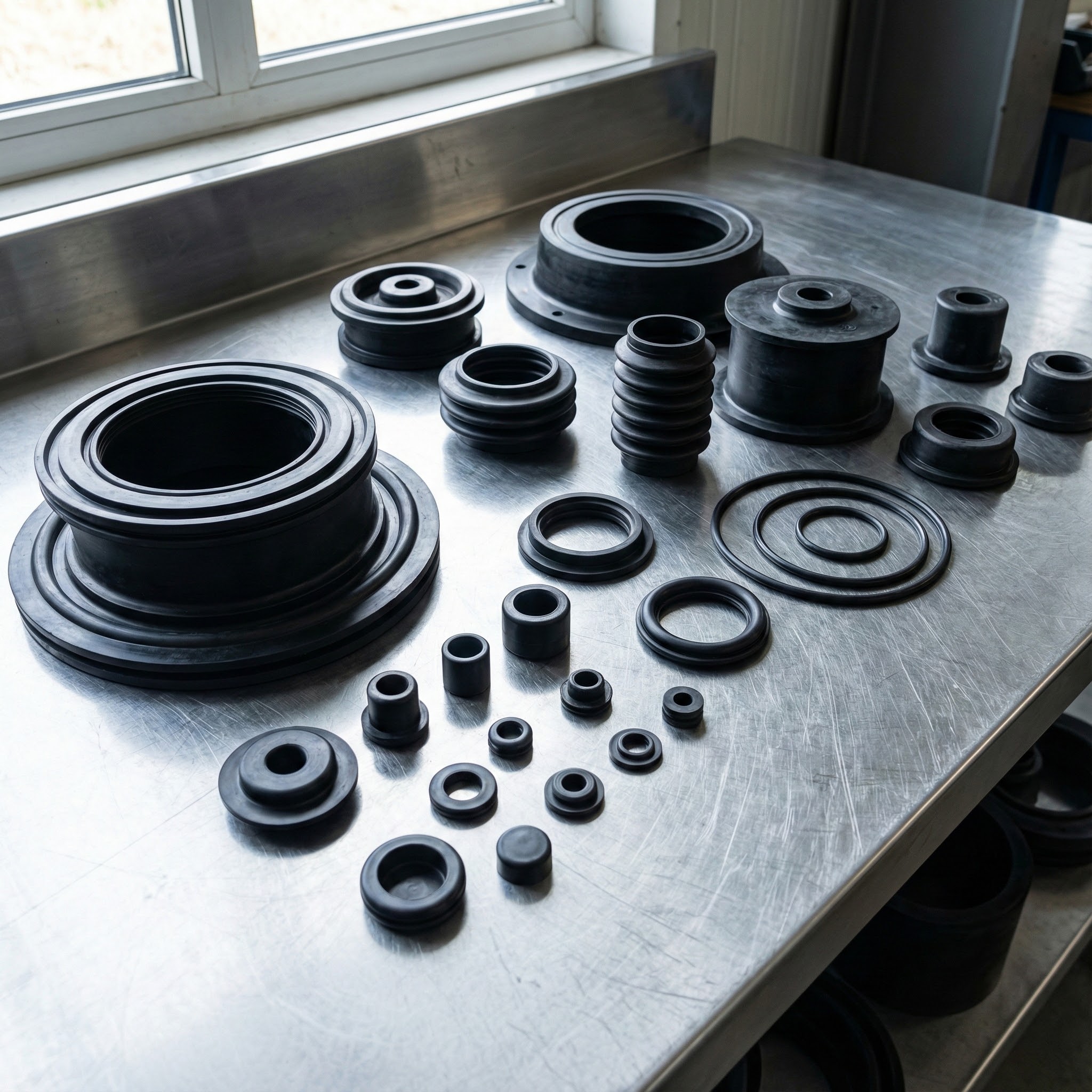
Materials Used for Molded Rubber Parts
Technical Selection According to Application and Industry
The choice of elastomer is a critical factor in the performance and service life of molded rubber parts. At Élastomont, each material is selected based on real operating conditions: continuous service temperature, chemical exposure, abrasion, mechanical cycles, pressure, and applicable standards.
The temperature ranges indicated correspond to typical values in industrial service and may vary depending on the formulation, medium, and usage cycle.
Natural Rubber (NR)
Natural rubber offers excellent resilience, very high tensile strength, tear resistance, and abrasion resistance, making it a reference material for dynamic applications and wear-resistant linings.
It is not very compatible with oils, solvents, or acids.
Continuous Service Temperature (typical): −50 °C to +80 °C
Typical parts
Wear plates, slides, dampers, skirts, thick molded parts, anti-abrasion linings
Industries
Mines, quarries, mineral processing, bulk material handling, heavy industry
SBR (Styrene-Butadiene Rubber)
SBR is an economical synthetic elastomer offering good resistance to abrasion and mechanical shock for applications with moderate stress.
Its chemical resistance is limited.
Continuous Service Temperature (typical): −40 °C to +90 °C
Typical parts
Flat seals, washers, skirts, protections, non-critical molded parts
Industries
General manufacturing, standard industrial equipment, maintenance
Nitrile (NBR)
NBR is widely used for its high compatibility with oils, fuels, and hydraulic fluids while maintaining good mechanical properties in oily environments.
Continuous Service Temperature (typical): −30 °C à +110 °C
Possible Peak : Up to +120 °C depending on formulation
Typical parts
O-rings, molded seals, membranes, hoses, hydraulic parts
Industries
Hydraulics, oil and gas, industrial machinery, transportation
XNBR (Carboxylated Nitrile)
XNBR is an enhanced version of NBR offering superior wear resistance and improved metal-rubber adhesion, ideal for parts subjected to friction and mechanical load.
Continuous Service Temperature (typical): −30 °C to +110 °C
Typical parts
Molded parts with metal inserts, wear-resistant seals, scrapers
Industries
Mines, heavy industrial equipment, friction mechanical systems
HNBR (Hydrogenated Nitrile)
HNBR combines the chemical resistance of NBR with superior thermal, mechanical, and ozone resistance. It is adapted to severe environments and long-service-life applications.
Continuous Service Temperature (typical): −30 °C to +140 °C
Possible Peak : Up to +150 °C
Typical parts
High-performance seals, hydraulic components, automotive parts
Industries
Automotive, energy, high-performance hydraulics, critical equipment
EPDM (Ethylene-Propylene-Diene)
EPDM is recognized for its exceptional stability against heat, steam, ozone, and UV exposure.
It is incompatible with mineral oils and hydrocarbons.
Continuous Service Temperature (typical): −40 °C à +130 °C
Pointe possible : jusqu’à +150 °C
Pièces typiques
Joints vapeur, joints d’eau, membranes, pièces d’étanchéité extérieure.
Industries
Traitement de l’eau, vapeur industrielle, énergie, bâtiment industriel.
Neoprene (CR)
Neoprene is a versatile elastomer offering good balance between mechanical, chemical, and environmental resistance, with moderate oil resistance.
Continuous Service Temperature (typical): −35 °C to +90 °C
Possible Peak: Up to +120 °C
Typical parts
Seals, gaskets, steam hoses, radiators, cable sheathing, electrical insulation, marine components
Industries
Marine, automotive, industrial equipment, electrical applications
Hypalon (CSM)
Hypalon (CSM) offers excellent resistance to oxidation, ozone, and chemicals, and is self-extinguishing. Highly stable, it withstands heat and hydrocarbons.
Continuous Service Temperature (typical): −40 °C to +150 °C
Possible Peak: Up to +150 °C
Typical parts
Acid-resistant linings, cable sheaths, membranes, exterior protections, parts exposed to hot oils
Industries
Chemical processing, energy, marine, industrial protection
Butyl (IIR)
Butyl stands out for its exceptional impermeability to gases and steam, and excellent resistance to polar chemicals, water, and heat. It has limited compatibility with oils but is ideal for closed chemical environments.
Continuous Service Temperature (typical): −45 °C to +125 °C
Typical Parts
Gas-tight seals, tank interior linings, inner tubes, hoses, membranes
Industries
Chemical storage, energy, pharmaceutical, sealed systems
Silicone (VMQ)
Silicone offers exceptional thermal and chemical stability from −60 °C to +230 °C while remaining flexible at low temperatures. It has very good electrical properties and excellent resistance to ozone and weathering, but limited resistance to oils and abrasion.
Its mechanical and abrasion resistance is limited.
Continuous Service Temperature (typical): −60 °C to +200 °C
Possible Peak: up to +230°C
Typical parts
Static seals, insulators, food and medical parts (FDA grade), high-temperature applications
Industries
Medical, food processing, aerospace, high-temperature applications
Fluorosilicone (FVMQ)
FVMQ combines silicone flexibility with improved resistance to fuels, oils, and aromatic solvents. Stable from −60 °C to +200 °C, it is ideal for environments with wide temperature fluctuations.
Continuous Service Temperature (typical): −60 °C to +180 °C
Possible Peak: up to +200 °C
Typical Parts
Fuel seals, aerospace components, membranes, precision sealing, high-end equipment
Industries
Aerospace, automotive, energy, high-performance equipment
Polyurethane (PU)
Polyurethane offers exceptional mechanical, tensile, tear, and abrasion resistance, with excellent resilience. It performs well with oils but only moderately with acids and solvents.
Continuous Service Temperature (typical): −40 °C to +90 °C
Possible Peak: up to +90 °C
Typical parts
Pads, rollers, scrapers, dampers, stops, wheels, wear parts
Industries
Material handling, manufacturing, industrial equipment, wear applications
Viton® / FKM
Viton® (FKM) is the elastomer of choice for extreme conditions: outstanding resistance to heat, oils, solvents, acids, and aromatic hydrocarbons. It maintains elasticity up to +250 °C and ensures durable sealing.
Continuous Service Temperature (typical): −20 °C to +200 °C
Possible tip depending on grade : up to +250°C
Typical parts
High-performance seals, fuel and lubrication system components, automotive and aerospace parts
Industries
Automotive, aerospace, chemical processing, energy, high-performance applications
Important Note
This comparison serves as a general guide; each project must be evaluated individually. Materials can be formulated or modified to optimize chemical, mechanical, or regulatory properties (FDA/NSF/UL/MIL/ASTM), including metal-to-rubber adhesion, hardness, elasticity, or resistance to wear and heat. Specialized additives (flame retardants, UV stabilizers, antistatic agents, pigments, plasticizers) allow each formulation to be tailored. The final selection must be validated by an engineer or polymer specialist according to the exact operating conditions.
Example of products: Shooting Range Rubber, Star Sorting Wheel


.png)