Rubber and Polyurethane Roll Covering

Elastomont delivers comprehensive roll covering and refurbishment services, meeting the exacting standards of the paper, steel, and converting industries. Unlike standard lagging, our process integrates hot autoclave vulcanization with high-precision CNC machining. We don't just recover your rollers; we restore them to OEM specifications with guaranteed concentricity. Whether you require a high-release silicone coating, a durable polyurethane drive roll, or a custom-grooved spreader, our engineering team optimizes every surface for traction, release, and wear resistance.

Our services

Each project starts with a thorough analysis of your application. Our integrated service offering ensures that each roll is optimized for maximum performance and longevity:

  • New and refurbished upholstery : steel, aluminum, composites
  • Surfacing and grinding : diameter, parallelism, roughness (Ra/Rz)
  • Bonding and primers : long-lasting adhesion on all types of substrates
  • Dynamic balancing : for high line speed and maximum precision
  • Inspection & traceability : hardness, concentricity, batch code and tracking sheet
  • On-site support : wear diagnosis, slipping/skating, product marking, technical recommendations
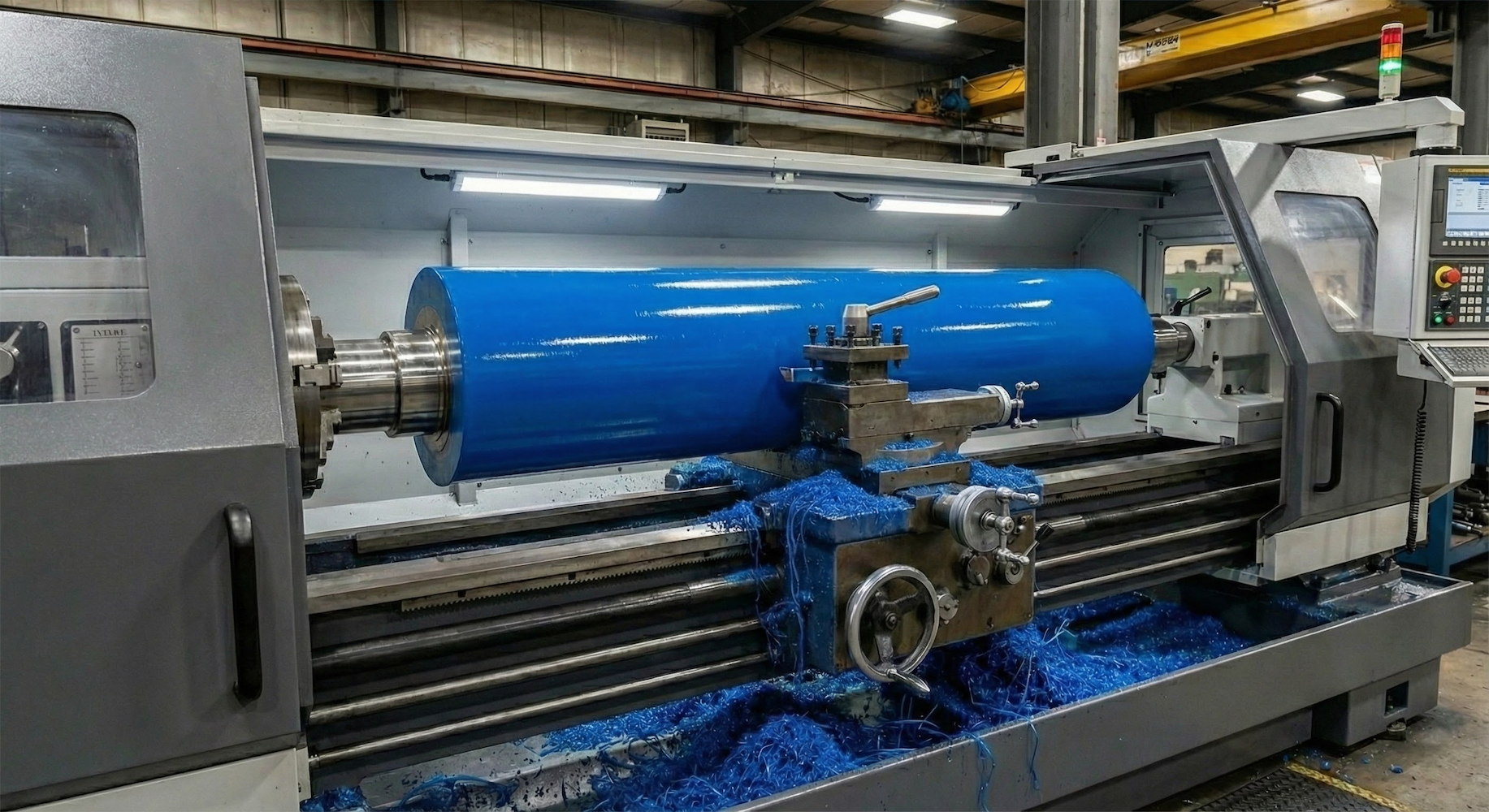
Turning operation on a conventional lathe of a large industrial nip roll featuring a 2-inch thick blue polyurethane cover. The image shows blue polyurethane ribbons and shavings on the carriage, contrasting with the precision-polished steel bearing journals.
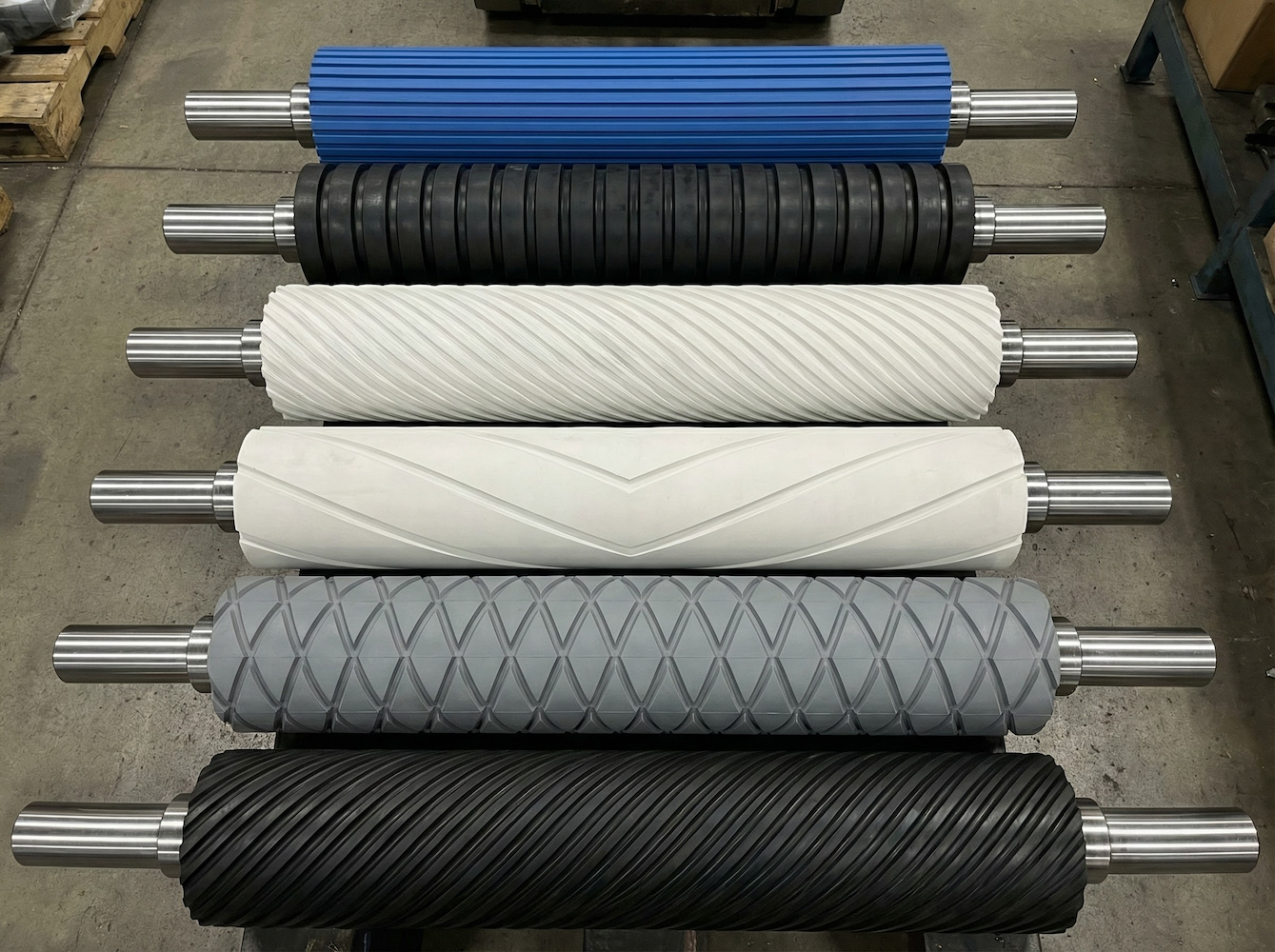
Grooved industrial rollers featuring various patterns: chevron, diamond, spiral, and horizontal. Made from materials such as SBR, nitrile, or traction polyurethane.

Geometry and surface finishes

The surface finish of a roller directly influences adhesion, traction, liquid retention and the precision of contact with the product. Elastomont offers a complete range of mechanical finishes and surface profiles adapted to each application:

Finish types

  • Smooth polished — ideal for traction or drive rollers without material transfer.
  • Matt or micro-grained — control of the coefficient of friction to avoid sliding or marking.
  • Grooved — improves the drainage, traction or distribution of liquid depending on the pattern:
  • Diamond Groove : multidirectional traction, widely used in textiles, films and wet conveying.
  • Chevron or spiral groove : promotes the evacuation of water, air or residues.
  • Longitudinal or cross groove : to guide or channel the flow of liquid.
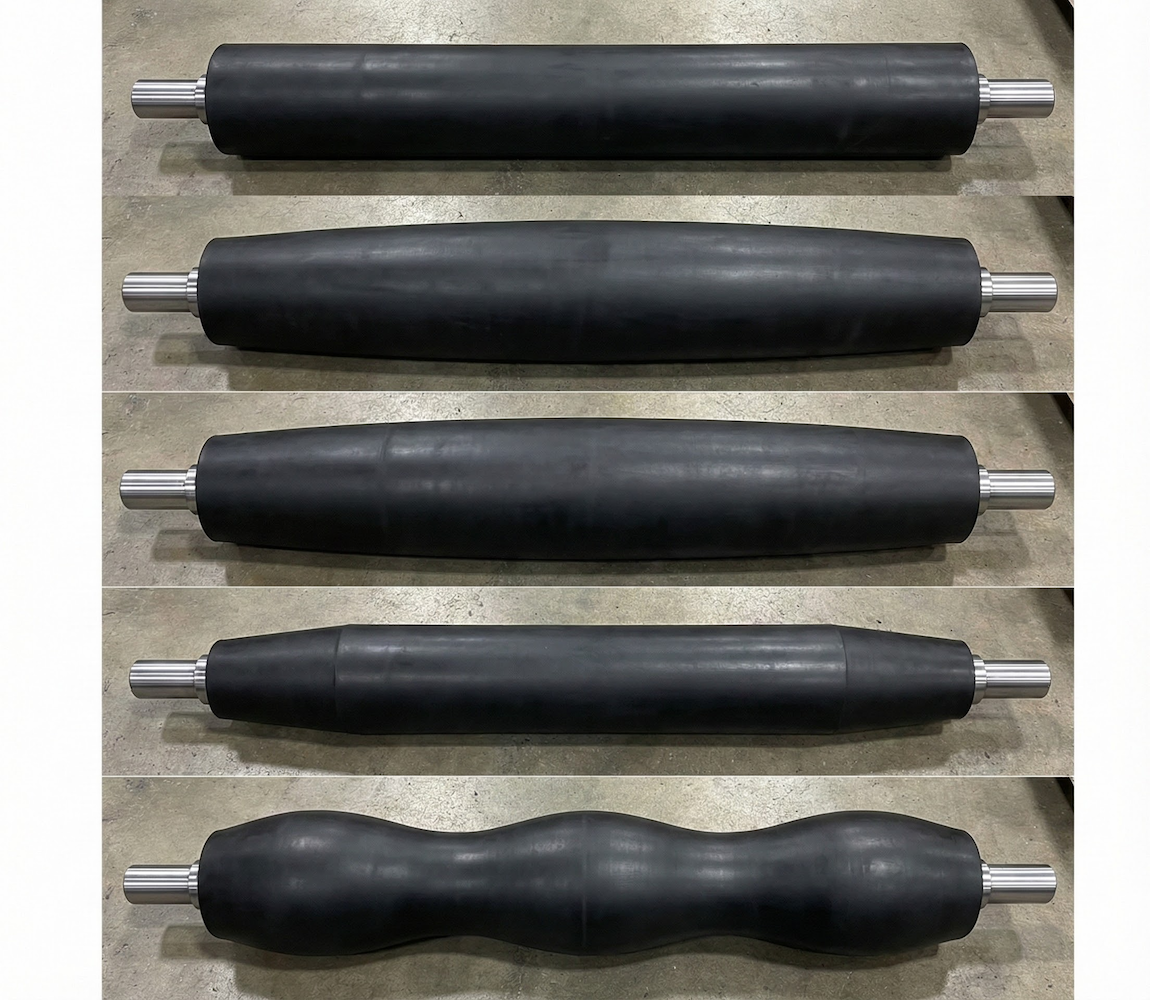
A photograph displaying a set of five black industrial rubber rollers arranged horizontally on a highly reflective concrete floor. From top to bottom, the rollers feature different finishes: a smooth cylindrical profile, a crown (convex) profile, a reverse crown (concave) profile, a taper crown profile with conical ends, and an undulating profile.

Profiles (roller geometry)

Depending on the mechanical function, the rollers can be machined with different profiles:

  • Domed (crown) : natural correction of the decentration or tension of the web; convex profile adjusted according to the useful width.
  • Concave (reverse crown) : for certain drive or reverse tension configurations.
  • Conical (type) : precise adjustment for conveyors or accumulation rollers, promoting automatic recentering.
  • Rectified cylindrical : for uniform contact over the entire width, tight parallelism and concentricity tolerances.

Each finish is measured, documented, and traceable (Ra/Rz, profile, pattern) according to customer specifications and process requirements.

Process and Quality Control

Repeatability is the foundation of reliability. Our rigorous quality process ensures that each roller meets specifications, lot after lot.

  • Application analysis: product/film, chemistry, temperature, speed, forces
  • Compound & primer selection for durable core-coating adhesion
  • Vulcanization / bonding according to our standardized procedures
  • Machining & surfacing to achieve required tolerances and finish
  • Controls: Shore hardness, concentricity, roughness, visual inspection
  • Traceability (tracking): part identification, material lot, operator, date and parameters

Material Selection Guide: Properties & Applications

Choosing the right compound is critical for roller performance. Our expertise covers a wide range of standard and technical elastomers to meet specific requirements for abrasion, chemical resistance, and temperature.

Material Key Advantages Limitations Typical Applications
Polyurethane (PU) Exceptional abrasion & impact resistance; wide hardness range; good oil/water resistance. Not flame resistant; poor resistance to chlorinated solvents. Drive rolls, heavy-duty pads, load wheels, high-wear areas.
Nitrile (NBR / Buna-N) Excellent resistance to oils, fuels, hydraulic fluids, and mild acids/alkalis. Poor resistance to ozone/UV and oxygenated solvents (ketones). Oil & grease contact rolls, lubricated process lines, printing rolls.
HNBR (Hydrogenated Nitrile) Superior heat & oil resistance (-30 °C to +150 °C); better abrasion/ozone resistance than NBR. Higher cost than standard NBR. High-temp oily environments, automotive & technical rollers.
XNBR (Carboxylated Nitrile) Enhanced abrasion and wear resistance compared to standard NBR; good chemical resistance. Bonding and tensile properties can be sensitive. Severe service conditions requiring both oil & wear resistance.
EPDM Excellent resistance to water, steam, acids, alkalis, heat, ozone, and UV. Poor resistance to oils, gasoline, and hydrocarbon solvents. Outdoor use, steam/water processing, conveyor belts, weather seals.
Silicone High thermal stability; excellent release (non-stick) properties; UV/Ozone resistant; inert. Lower tensile and tear strength; not for high abrasion. Food/Medical grade rolls, adhesive coating lines, high-heat sealing.
FVMQ (Fluorosilicone) Combines silicone's temp range with fuel/oil resistance; excellent weather/UV stability. Lower physical strength (tear/tensile). Aerospace fuel systems, static seals, extreme temp & fluid contact.
Neoprene (CR) Balanced properties: good weather/ozone resistance; strong metal adhesion; moderate oil resistance. Poor resistance to aromatic and oxygenated solvents. General outdoor use, light oil contact, wire sheathing.
SBR (Red Rubber) Good resilience, impact strength, and abrasion resistance; flexible at low temps. Poor resistance to oils, gasoline, and ozone. General purpose non-critical rolls, skirting, Grade II belts.
Hypalon (CSM) Excellent weathering/ozone resistance; resistant to inorganic chemicals; self-extinguishing. Caution required with concentrated chlorine or strong acids. Acid-resistant linings, cable jacketing, chemical processing rolls.
Natural Rubber (NR) Superior elasticity, resilience, and abrasion resistance (cut/tear). Poor resistance to heat, ozone, oils, and solvents. Heavy-duty wear parts: mining chutes, cyclones, slurry handling.
Butyl (IIR) Exceptional impermeability to gases/air; high vibration damping/shock absorption. Poor resistance to oils and gasoline; high compression set. Air/Gas sealing, inner tubes, acid tank linings.
FKM (Viton™) Extreme heat resistance; superior chemical resistance (hydrocarbons, solvents); low compression set. High cost; poor resistance to ketones/esters. Chemical processing, energy sector, high-temp aggressive fluids.
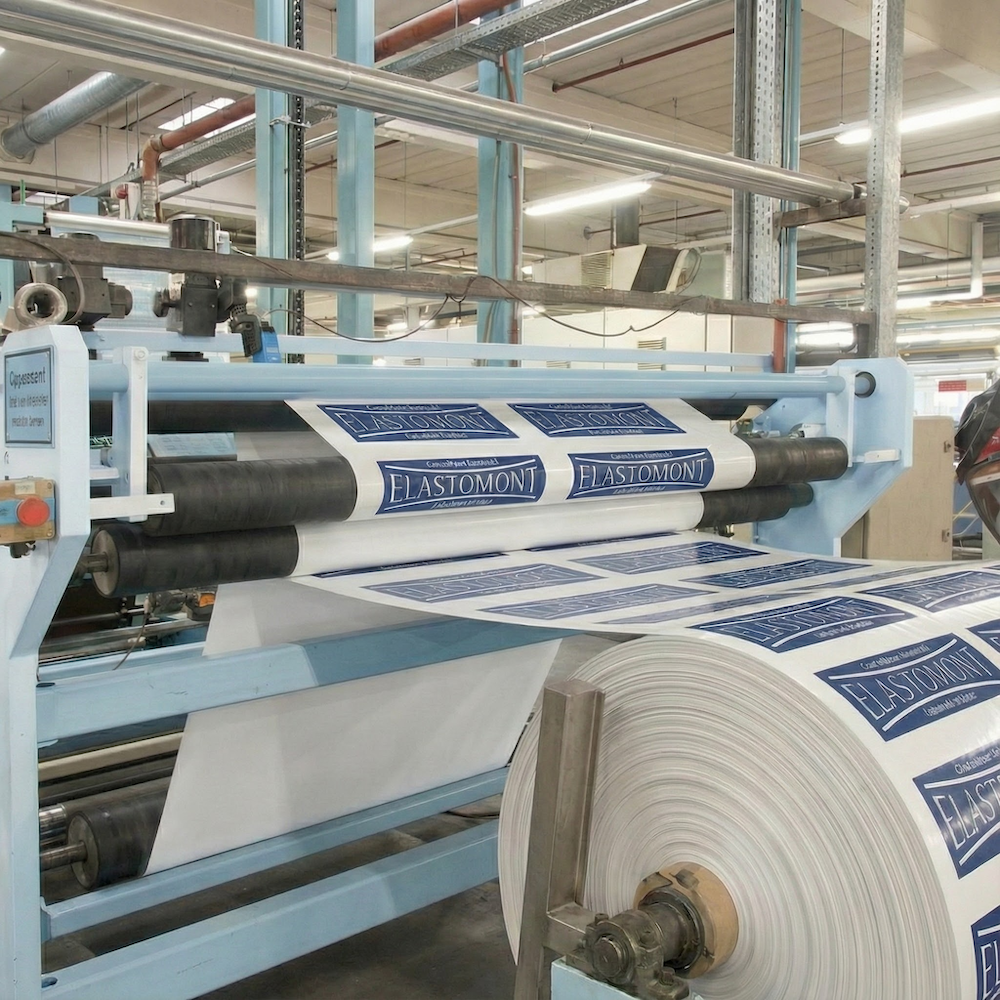
Pale blue and white industrial machine equipped with Elastomont matte black nitrile rubber rollers, processing white film printed with the company logo.

Industries served

  • Mining & processing
  • Wood
  • Metallurgy & aluminum smelters
  • Textile & nonwovens
  • Paper & cardboard
  • Packaging & logistics
  • Food and pharmaceutical
  • General manufacturing & automated lines

FAQ - Rubber Roll Covering

Standard production is typically 2 to 3 weeks. However, for breakdown situations, we offer a dedicated Emergency Rush Service to strip, vulcanize, and grind critical rollers in as little as 24 to 48 hours (including weekends), getting your production line back up immediately.
Yes. For clients in the Greater Montreal area, Laval, and across Quebec, we offer a direct pickup and delivery service with our own trucks to ensure safe handling. For clients elsewhere in Canada and the USA, we coordinate expedited freight logistics to minimize transit time.
We are equipped to handle large-scale industrial rollers. Our heavy-duty lathes and autoclaves can accommodate rollers up to 60’’ in diameter and 240’’ in length. Whether it’s a small labeling roller or a massive paper mill suction roll, we have the capacity.
Yes. If your roller has sufficient rubber thickness remaining but the surface is glazed, worn, or uneven, we can perform a precision re-grind (refinishing). We remove a minimal amount of material to restore a fresh, tacky surface and perfect concentricity (T.I.R.), extending the life of your roller at a fraction of the cost of a full recover.
Absolutely. We are a "one-stop shop." Before covering, we inspect every core. If we find worn bearing journals, damaged keyways, or bent shafts, we perform metalizing and machining repairs in-house to restore the core to OEM tolerances.
To provide an accurate quote, please provide: the Overall Length (OAL) and Face Length, the Core Diameter and Finished Diameter, the desired Material (e.g., Nitrile, Urethane), and the Hardness (Durometer). If you are unsure, simply send us the roller or a photo/drawing, and our engineering team will identify the specs for you.
This is known as delamination. It is often caused by poor surface preparation or thermal shock. Unlike cold-bonded lagging, our hot autoclave vulcanization process creates a chemical bond between the metal and rubber that is virtually inseparable. We strip the failed cover and apply a fresh, chemically bonded system designed to withstand high torque.
This is likely due to hysteresis (internal heat buildup). When a roller runs at high speeds, the rubber repeatedly compresses and generates heat. We solve this by engineering "cool-running" compounds with low hysteresis properties specifically formulated for high-speed load bearing applications.
Wrinkling usually indicates that the roller is not compensating for deflection (bending under load). We solve this by machining a precise Parabolic Crown (making the center slightly larger than the ends) or by cutting Chevron/Spreader grooves to push the web outward and ensure straight tracking.
This is a sign of chemical attack. Your current rubber compound is incompatible with the solvents, oils, or inks used in your process. We can analyze your chemical environment and recover your roller with a resistant material like Nitrile (for oils), EPDM (for acids/ketones), or Viton™ (for extreme chemicals).
Uneven wear or vibration often results from poor concentricity (T.I.R.) or a lack of dynamic balancing. If a roller isn't perfectly round, it "bounces" at high speeds. Our process includes dynamic balancing to ISO standards and precision cylindrical grinding to ensure the roller is vibration-free.
It’s a trade-off. Softer rubber (20-40 Shore A) provides better grip (traction) but wears faster. Harder rubber (70-90 Shore A) offers better durability and fluid release but less traction. We calculate the optimal durometer based on your specific nip pressure and speed requirements to maximize performance.

Ready to optimize your rolls?

Our team is at your disposal to analyze your application and recommend the most sustainable and productive solution.

Request a quote today

Knowledge Base: Partial List of Rollers & Wheels by Application

Conveyor & Material Handling Rollers

  • Drive Roll (Motorized Conveyor): High-traction lagging for heavy industry, mining, and lumber. (Material: Natural Rubber or PU)
  • Return Idler: Standard support rollers for the underside of conveyor belts. (Material: Abrasion-Resistant Rubber)
  • Impact Idler: Heavy-duty rollers installed at loading zones to absorb shock. (Material: Rubber with Cushion Inserts)
  • Training Idler: Self-aligning rollers to correct belt tracking issues. (Material: High-Grip Rubber)
  • Tapered Roller: Conical rollers for accumulation conveyors and curve sections. (Material: Polyurethane)
  • Grooved Idler: Custom-grooved for guiding cables, wires, or round belts. (Material: PU)

Industrial Wheels & Casters

  • Forklift & Pallet Jack Wheels: High-load bearing replacements for logistics equipment. (Material: High-Tensile PU)
  • Heavy-Duty Platform Wheels: For manufacturing carts carrying extreme weights. (Material: Reinforced PU or Hard Rubber)
  • Guide Wheels: Precision wheels for guiding films, metals, or automated systems. (Material: Hard PU)
  • Friction Drive Wheels: Wheel used to transmit power via contact friction. (Material: Natural Rubber or NBR)
  • Feed Wheels: Soft-touch wheels for feeding wood, paper, or textiles without marking. (Material: Soft PU or Neoprene)

Process & Coating Rollers (Paper, Film, Wood)

  • Applicator Roll: Applies glue, paint, or varnish evenly. (Material: Chemical-Resistant Rubber or PU)
  • Metering Roll: Controls the thickness of the coating application. (Material: Precision-Ground PU)
  • Squeeze / Wringer Roll: Removes excess liquid from the product. (Material: Hypalon or EPDM)
  • Printing Roll: Transfers ink in flexographic or offset processes. (Material: NBR or EPDM)
  • Silicone / Non-Stick Roll: For handling adhesives or food products where release is critical. (Material: Silicone or Treated PU)

Web Handling & Converting Rollers

  • Spreader / Banana Roll: Bowed rollers designed to remove wrinkles from film or fabric. (Material: Grooved PU)
  • Nip / Laminating Roll: Presses two materials together (e.g., plastic to paper). (Material: Uniform Hardness Rubber)
  • Accumulator Roll: Stores web material during splice cycles. (Material: Low-Inertia PU)
  • Unwind & Rewind Rolls: Core holding rollers for the start and end of the line. (Material: Durable PU)
  • Chill Roll & Heated Roll: Temperature-controlled rollers for extrusion or thermoforming. (Material: Heat-Resistant Silicone or Hard PU)

Specialty Industry Rolls

  • Paper Mill Press Roll: Dewatering rollers for the wet section of paper machines. (Material: Drilled/Grooved Rubber)
  • Textile Padder Roll: Dye impregnation rollers requiring high chemical resistance. (Material: NBR)
  • Steel Mill Bridle Roll: High-tension rolls for guiding metal strip. (Material: Cut-Resistant PU)

Call us