


elastoWear-Urethane Wear Panels

The elastoWear-Urethane panels offer exceptional abrasion resistance, excellent impact absorption, noise reduction, and good resistance to corrosion and chemicals. They are ideal for handling wet or sticky bulk materials thanks to low coefficient of friction formulations that reduce adhesion and material buildup.
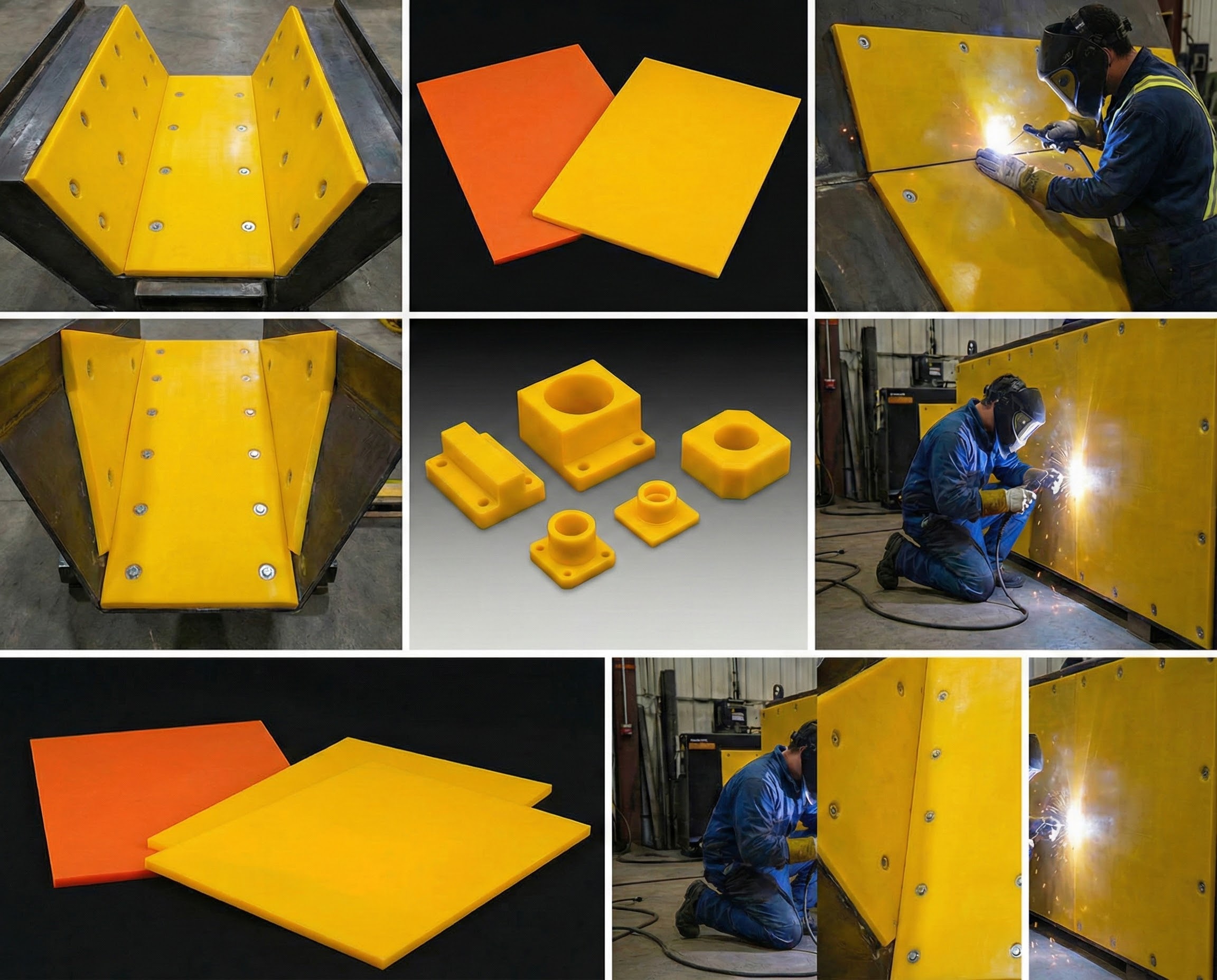

What Are the Advantages of Polyurethane Wear Panels?

  • Abrasion and Impact-Resistant Elastomer with reduced weight for easier handling and installation.
  • Reduced Adhesion and Buildup: Low-friction options maintain material flow under dry, wet, or cold conditions.
  • Noise Reduction and Corrosion Protection of the steel substrate.
  • Typical Thickness: 1/2″ to 4″ (depending on application).
  • Special Options: Anti-static, High Temperature.

Products & Applications

  • Bolt-On Fastening: Modular plates or sheets; recommended for hoppers, discharge chutes, feed boxes, and troughs.
  • Weldable (Steel Support / Stud Welding): No shell perforation; continuous protection; common on chutes, trucks/bins, distribution heads, and transfer points.
  • Flexible Weldable: Malleable tiles for hard-to-reach areas; quick snap-on installation.
  • Adhesive-Bonded (with Adhesive): Smooth internal surface (reduced adhesion); joints and perimeters sealed with RTV per procedure.
  • PU Sheets/Plates: For spouts, hoppers/silos, chutes/ducts, troughs, elbows, cyclones (<4000 fpm), deflector plates, and truck beds.

Quick Selection Table

Application Recommended Configuration Typical Thickness Hardness (Shore A) Fastening
Transfer Points (high-velocity fines) Low-friction PU sheet 1/2″–1″ 85A–90A Adhesive or bolt-on
Impact/Reception Zone Reinforced/ribbed PU plate 1″–2″ 92A Bolted or weldable on steel
Sticky Hoppers/Silos Low-friction PU sheet 1/2″–1″ 85A–90A Adhesive (RTV at joints)
Grizzly/Rock Box/Truck Beds Heavy-duty PU plate 2″–4″ 92A Bolted/Weldable
Elbows & Ducts/Cyclones (<4000 fpm) Smooth PU lining 1/2″–1″ 85A–90A Adhesive or bolt-on
Mixers/Vibrating Hoppers Molded PU tiles 1″–2″ 92A Bolted (dedicated pattern)

Thickness vs. Hardness (Reference)

Service Typical Thickness Typical Hardness
Sliding/Velocity (fines, low impact) 1/2″ – 1″ 85A–90A
Mixed Service/Moderate Impact 1″ – 2″ 90A–92A
Severe Impact/Point Loads 2″ – 4″ 92A

Overview of Our Polyurethane Solutions

In addition to the wear panels presented above, Élastomont offers various polyurethane solutions used as parts, liners, and protections for industrial equipment subject to wear, impact, and abrasion. These solutions allow polyurethane to be adapted to a wide variety of configurations and industrial applications, both for new installations and rapid replacements.

We also offer polyurethane sheets in standard 4' × 10' format, as well as custom sizes, according to the thicknesses indicated in the tables above. Depending on the application, they can be glued, bolted, welded, or magnetically fastened, and are easy to cut on-site for rapid and efficient installation.

Polyurethane Parts Common Applications Industries Served
Polyurethane Parts
  • Wear Sheets and Panels
  • Prefabricated Liners
  • Molded Wear Parts
  • Internal Protections
  • Sliding Plates
  • Protective Coatings
Common Applications
  • Chute and Spout Lining
  • Transfer and Impact Zones
  • Conveyors and Material Handling Systems
  • Mixers, Tanks, and Rotating Equipment
  • Friction and Buildup Reduction
  • Metal Protection Against Wear
Industries Served
  • Mining and Quarries
  • Aggregates and Cement
  • Recycling
  • Grain and Agriculture
  • Food Processing
  • Bulk Material Handling

FAQ — Polyurethane Wear Panels

Generally 1/2″ to 4″ depending on impact energy, velocity, and target stiffness; we confirm after analyzing your process data.
Bolting is versatile and fully removable. Welding uses a steel backing and stud welds — no shell perforation; common in aggregate applications.
Malleable tiles that conform to geometry; quick snap-on installation for hard-to-reach areas.
Smooth interior surface; follow appropriate surface preparation and select adhesive based on temperature/chemistry. Seal joints/perimeters with RTV.
Yes, especially with low-friction compounds that reduce adhesion and buildup.

Call us