

Rubber Extrusions

Elastomont manufactures custom extruded rubber profiles engineered to meet the exact specifications of your industrial equipment. Whether you need to replace obsolete OEM seals, design a new prototype, or improve chemical and abrasion resistance, our engineering team delivers optimal solutions. We specialize in custom die design to produce complex geometries—from simple tubing to intricate sealing profiles—that extend component lifespan and reduce maintenance costs

Complete extrusion capabilities: Solid or sponge profiles, co-extrusion, color matching, precision cutting, vulcanization in endless seals. We work with all types of compounds (Silicone, EPDM, Neoprene, Nitrile, SBR, Viton, Fluorosilicone, SMP-800C) and comply with required industrial certifications: FDA/NSF (food), RoHS, UL, USP Class VI (medical), ASTM and military specifications.

Talk to our specialists
NéoprèneStyrène-ButadièneHNBRXNBRSiliconeÉthylène propylène dièneHypalonCaoutchouc naturelButyleNitrileFluorosiliconePolyuréthaneViton

Custom Rubber Extrusion Solutions

Rubber extrusion is an industrial process that transforms an elastomer compound into custom continuous profiles. By forcing the material through a die, we manufacture seals, tubes, strips and technical profiles perfectly adapted to your equipment and production lines. Each part is designed to meet your specifications in terms of dimensions, hardness, chemical resistance, thermal and mechanical properties.

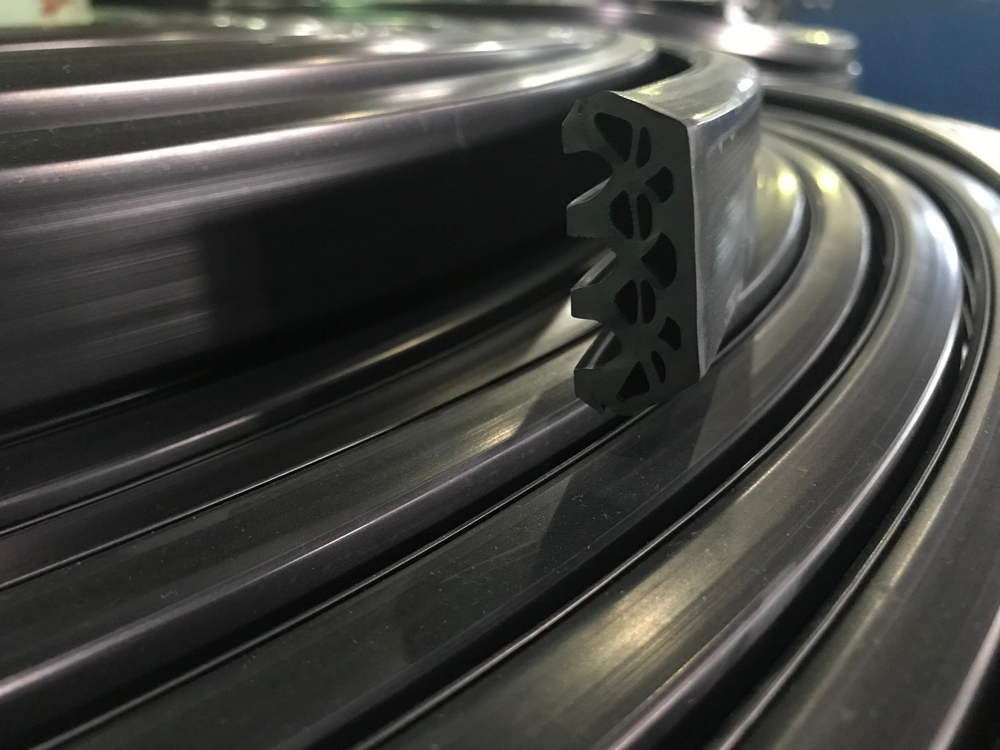
Custom SBR rubber extrusion profile illustrating tailored rubber extrusion solutions for industrial equipment and production lines.

Why Choose Custom Extrusion?

  • Precise adaptation: Each profile is dimensioned according to your exact tolerances, ensuring a perfect seal and fit for your machinery.
  • Material versatility: From standard natural rubber to high-performance compounds (Viton™, Silicone, EPDM) compliant with FDA, UL, and Military Specifications.
  • Continuous production: Capable of extruding continuous profiles from a few meters to large-scale runs with rigorous in-line laser inspection.
  • Complete solutions: We offer value-added finishing including vulcanization into endless O-rings, precision cutting, drilling, and taping.

Typical Industrial Applications

  • Food, Beverage & Pharma: FDA/NSF certified high-purity tubing, dairy seals, and transfer hoses.
  • Automotive & Transportation: Weather stripping, window gaskets, anti-vibration mounting pads, and custom trims.
  • Energy & Chemical Processing: High-temperature Viton™ seals, chemical-resistant expansion joints, and cable jacketing.
  • Heavy Industry & Manufacturing: D-bumpers, conveyor skirting, protective edge guards, and structural glazing seals.

By choosing Elastomont for your rubber extrusion projects, you benefit from a turnkey process, from technical analysis and optimal compound selection to production and finishing. Our extruded profiles guarantee reliability, durability and compliance with the strictest industrial standards.

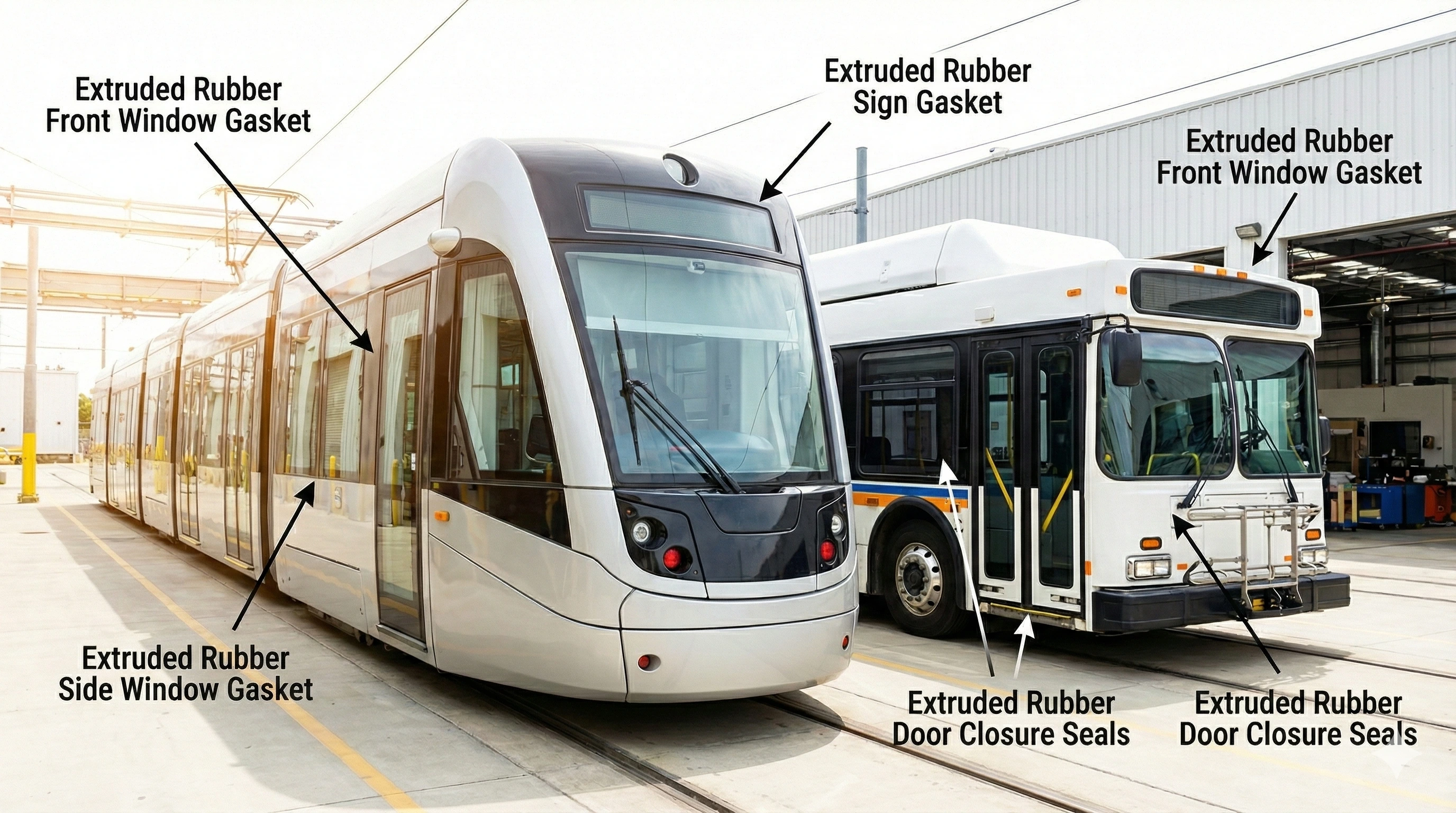
Technical diagram of a tramway and a bus showing the location of extruded rubber seals for doors and windows, illustrating Elastomont’s sealing solutions for the transportation industry.

Our Materials for Rubber Extrusion

We master the extrusion of a wide range of technical elastomers, each selected for its unique properties against abrasion, chemical agents, extreme temperatures or specific environmental conditions. Regardless of the material chosen, we can transform it into solid or foam (sponge) profiles, perform co-extrusions, and offer custom finishes such as dimensional cutting or vulcanization in endless seals for perfect sealing.

View chemical compatibility table

Elastomer Selection Guide

Extruded black neoprene rubber profiles in various geometries, formulated to provide high resistance to oils, flames, acids, and abrasion.

Neoprene Rubber Extrusion

Strengths:

  • Good inherent flame resistance
  • Moderate resistance to oil and gasoline
  • Excellent adhesion to fabrics and metals
  • Excellent weather, ozone and natural aging resistance
  • Good abrasion resistance and crack resistance from flexing
  • Very good resistance to alkalis and acids

Weaknesses:

  • Low resistance to aromatic and oxygenated solvents
  • Limited use at low temperature

Applications:

When slight oil resistance and weather resistance are both needed (sealing gaskets and washers, door and window sealant, steam, garden or radiator hose, wires and cables).

SBR Rubber Extrusion

Strengths:

  • Excellent shock resistance
  • Very good resilience
  • Elasticity and abrasion resistance
  • Flexibility at low temperature

Weaknesses:

  • Low resistance to aromatic and oxygenated solvents
  • Limited use at low temperature

Applications:

Non-critical and high-volume (sealing gaskets and washers, hose, rubber skirt, Grade II industrial belts).

Storage and logistics of extruded SBR (styrene-butadiene rubber) profiles used for high-volume, non-critical industrial applications requiring impact resistance, elasticity, and abrasion durability.
Extruded HNBR (hydrogenated nitrile rubber) profile providing excellent resistance to technical oils, ozone, wear, and heat up to 150 °C for demanding industrial applications.

HNBR Extrusion (Hydrogenated Nitrile)

Strengths:

  • High resistance to technical oils with additives
  • Low permeability to vapor and gases
  • Good low-temperature resistance down to –30°C, depending on type used
  • Good ozone resistance and high wear resistance
  • Resists heat up to +150°C

XNBR Extrusion (Carboxylated Nitrile)

Carboxylated nitrile rubbers (XNBR) are improved versions of NBR types that combine the technical properties of nitrile rubber (NBR) with improved wear resistance. It is primarily used for seals for heavy industrial applications.

Strengths:

  • High thermal resistance
  • Good anti-adhesive properties
  • Excellent chemical resistance
  • Good UV resistance

Weaknesses:

  • Low tensile strength
  • Low abrasion resistance
  • Difficult to bond

Applications:

  • Food industry
  • Industrial maintenance (high temperatures)
  • Sealing gaskets
Inspection of an extruded XNBR (carboxylated nitrile rubber) profile designed for heavy-duty industrial seals, providing enhanced wear resistance, chemical stability, and high-temperature performance.
Extruded silicone rubber profile that is physiologically inert, providing excellent thermal, chemical, and UV resistance for sealing applications in food processing and high-temperature industrial environments.

Silicone Rubber Extrusion

Silicone rubber is physiologically inert, allowing it to be used in a wide range of applications, particularly in the medical sector. It also remains very stable in hostile environments; its operating properties remain unchanged over a wide temperature range.

Strengths:

  • High thermal resistance
  • Good anti-adhesive properties
  • Excellent chemical resistance
  • Good UV resistance

Weaknesses:

  • Low tensile strength
  • Low abrasion resistance
  • Difficult to bond

Applications:

  • Food industry
  • Industrial maintenance (high temperatures)
  • Sealing gaskets
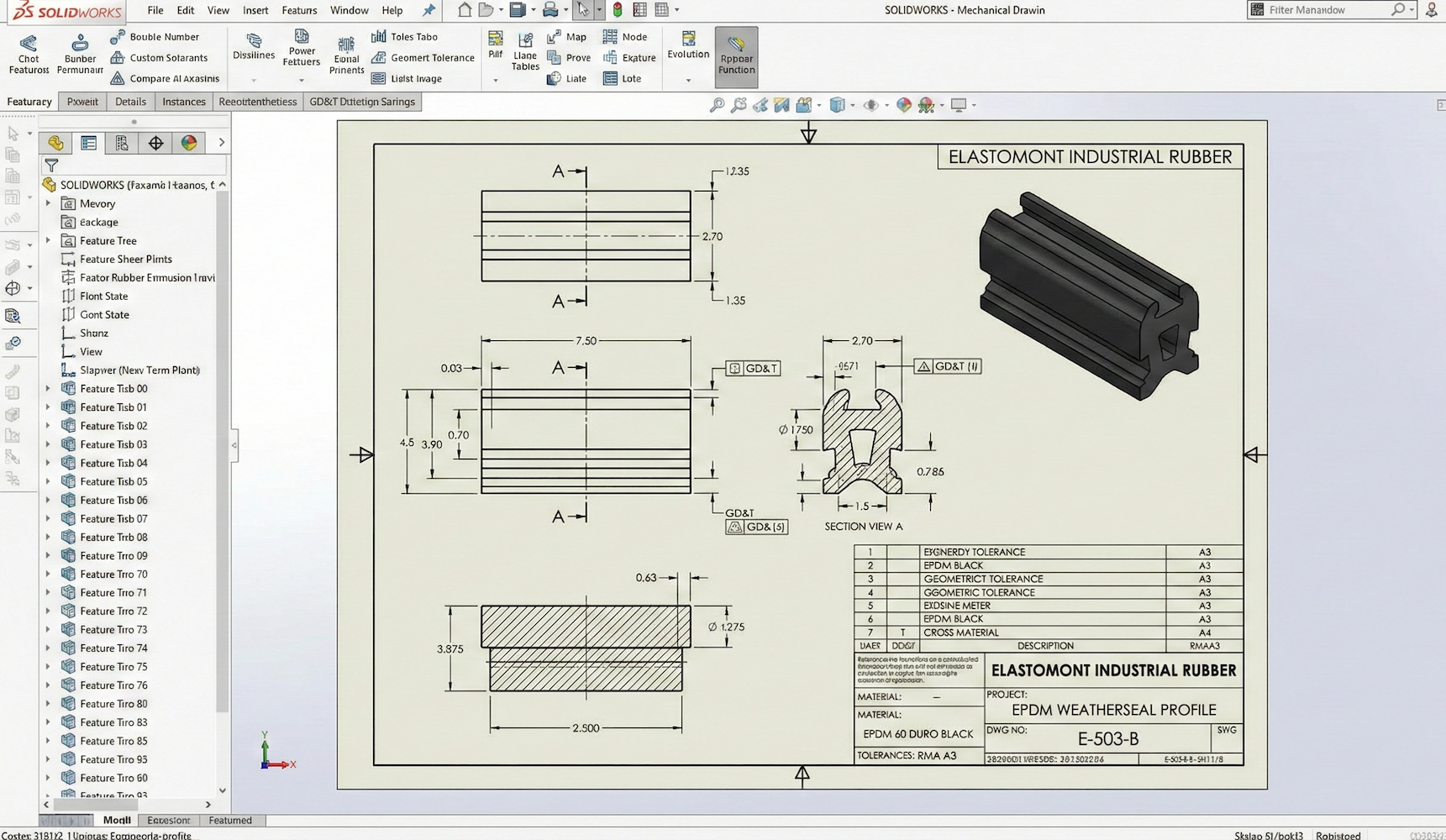
SolidWorks technical drawing of a complex rubber extrusion profile, computer-aided design used to validate custom extrusion solutions.

Ethylene Propylene Diene Rubber Extrusion

Strengths:

  • Excellent resistance to heat, ozone and sun rays
  • Very good flexibility at low temperature
  • Good resistance to alkalis, acids, oxygenated solvents, water and steam
  • Excellent color stability

Weaknesses:

  • Low resistance to oil, gasoline and solvents
  • Low adhesion to fabrics and metals

Applications:

  • Door and window seals
  • Sealing gaskets for the automotive sector
  • Sealing gaskets and washers for electrical equipment
  • Conveyor belts
  • Steam hose
  • Gardening or radiators
  • Caulking material

Hypalon Extrusion

Strengths:

  • Excellent oxidation and weather resistance, ozone and hydrocarbon solvents
  • Good fire resistance
  • Self-extinguishing
  • Resists most inorganic chemicals, Excellent UV resistance, Excellent ozone resistance

Les moins:

  • Limited use at high temperature, Low resistance to aromatic solvents, Difficult to bond

Applications:

  • Cables and sheaths
  • Hoses and tubing, Seals and gaskets, Anti-acid applications
Hypalon extrusion profile with excellent resistance to weathering, ozone, chemicals, and fire, manufactured by Elastomont specialists in Quebec, Canada.
Natural rubber extrusion profile with high abrasion resistance, made in Montreal, Quebec, Canada.

Natural Rubber Extrusion

Strengths:

  • Excellent elasticity and abrasion resistance
  • Excellent resilience and shock absorption
  • Excellent low-temperature flexibility
  • Very good adhesion to fabrics and metals, Good resistance to alkalis and acids, Good abrasion resistance and crack resistance from flexing

Les moins:

  • Low resistance to oil, gasoline and solvents
  • Low ozone and UV resistance, Limited use at high temperature

Applications:

Severe wear: conveying, slides, cyclones, Shock absorption and vibration damping, Sealing gaskets and washers

Butyl Rubber Extrusion

Strengths:

  • Excellent gas and vapor impermeability
  • Excellent damping properties
  • Good low-temperature flexibility
  • Good resistance to alkalis and acids
  • Excellent compression set resistance

Weaknesses:

  • Poor compression retention;
  • Low resilience;
  • Low resistance to oil and gasoline;
  • Difficult implementation.

Applications:

  • Sealing gaskets and washers
  • Inner tubes and hoses
  • Vibration damping
  • Pharmaceutical seals
Solid extruded butyl rubber (IIR) sealing profile designed to resist acids, bases, and corrosive vapors for industrial storage tanks.
High-performance extruded nitrile rubber (NBR) sealing profile designed to withstand direct contact with jet fuel and aviation hydraulic oils.

Nitrile Rubber Extrusion

Strengths:

  • Excellent resistance to mineral oils and synthetic oils
  • Excellent resistance to petroleum-based hydraulic fluids;
  • Good resistance to solvents;
  • Very good resistance to alkalis and acids.

Weaknesses:

  • Low resistance to ozone, sunlight, and natural aging;
  • Low resistance to oxygenated solvents.

Applications:

When oil resistance is the primary concern (seals for machines in contact with oil, grease, and gasoline; white goods certified for food contact; oil-resistant belts; pipe coatings; wires and cables).

Fluorosilicone Extrusion

Strengths:

Fluorosilicone rubber offers high heat resistance combined with excellent flexibility at low temperatures. It also has good electrical properties, excellent weather resistance, and excellent resistance to ozone and UV rays. Compared to standard silicones, fluorosilicones have significantly better chemical resistance to hydrocarbons, aromatic mineral oils, and low molecular weight aromatic hydrocarbons such as benzene and toluene.

Les moins:

  • Its low tensile strength and low resistance to tearing and abrasion.

Applications:

  • Static seals for fuel systems;
  • Aeronautical application, membranes;
  • Sealing gaskets.
Close-up of a complex-profile extruded black fluorosilicone rubber seal installed on an aircraft wing fuel tank access panel, demonstrating resistance to hydrocarbons in aerospace applications.
Assortment of extruded polyurethane profiles in various shapes and colors, including tubes, round rods, and square bars, providing high resistance to abrasion and oils.

Polyurethane Extrusion

Strengths:

  • Material offering a wide range of hardness;
  • Excellent mechanical properties: tear resistance, tensile strength, abrasion resistance, resilience, flexural strength, impact resistance;
  • Good resistance to oils, hydrocarbon derivatives, water, impermeability to gases.

Weaknesses:

  • Not resistant to flames or chlorinated solvents.

Applications:

  • Skates;
  • Scrapers;
  • Stops;
  • Shock absorbers;
  • Pebbles;
  • Rollers;
  • All technical parts requiring high abrasion resistance.

Viton Extrusion (FKM)

Strengths:

  • Unmatched resistance to heat, oxidation, ozone, and weathering;
  • Excellent resistance to a wide variety of fluids including aliphatic and aromatic hydrocarbons, halogenated fluids, strong acids;
  • Excellent resistance to deformation under pressure, offering sealing performance and durability unmatched by any non-fluorinated elastomer.

 Weaknesses:

  • Very high cost.

Applications:

  • Automobiles;
  • Aerospace;
  • Essences;
  • Lubricant;
  • Chemical process, energy, sealing joints.
Extruded Viton rubber profile providing outstanding resistance to heat, hydrocarbons, chemicals, and compression set for automotive, aerospace, and industrial sealing applications.
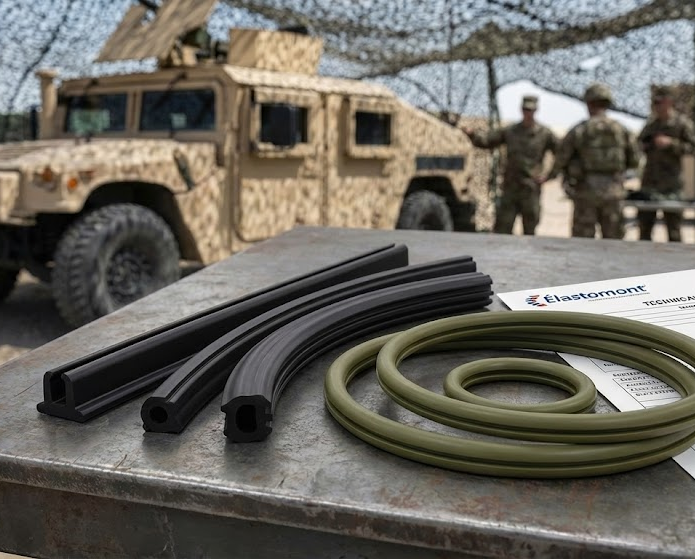
Extrusion of high-performance elastomer seals and profiles certified to MIL-SPEC and AMS standards for military and aerospace applications, designed to withstand jet fuel, extreme environments, and critical sealing requirements.

MIL-SPEC & AMS certified

MIL-SPEC & AMS Certified: Military & Aerospace Extrusions

Elastomont is a strategic partner for the defense and aerospace industries, delivering high-performance elastomeric sealing solutions. We manufacture precision extruded seals, tubing, and profiles that meet the most rigorous technical requirements, ensuring full interchangeability and critical resistance to hostile environments (cryogenics, jet fuel, ozone, saline atmospheres).

Our formulations comply with US Federal Specifications (MIL-DTL, MIL-STD) and Aerospace Standards (SAE AMS):

Fluorosilicone (FVMQ) – MIL-DTL-25988 (formerly MIL-R-25988, Type 2, Class 1):

Extrusions engineered for resistance to aromatic hydrocarbons, hydraulic fluids, and Jet Fuel (JP-4, JP-8). Vital for sealing aeronautical fuel tanks and systems where thermal and chemical stability is mission-critical.

Silicone (VMQ) – A-A-59588 (formerly ZZ-R-765):

  • Class 1A/1B: Low-temperature grades (-73°C / -100°F) for high-altitude performance and avionics insulation.
  • Class 2A/2B: High-temperature grades formulated for superior resistance to compression set.

Neoprene (CR) & Nitrile (NBR) – MIL-DTL-6855 (formerly MIL-R-6855):

  • Class 1 (Nitrile): Oil and fuel sealing for tactical ground vehicles.
  • Class 2 (Neoprene): Weather and oxidation resistance for naval applications and hatch seals.

Aerospace Specifications (AMS):

Custom manufacturing to SAE standards (e.g., AMS 3304 for Silicone, AMS 3216 for Viton™) for civil and defense applications requiring Low Outgassing and fire resistance properties.

Quality Assurance & Traceability: Every military production batch undergoes rigorous quality management. Upon request, we provide a complete Certificate of Conformity (CoC), including raw material traceability and physicochemical test reports compliant with contract requirements.

FAQ - Rubber Extrusions

Custom rubber extrusion is a manufacturing process that transforms elastomer compounds into continuous profiles with specific cross-sections. We force the material through a custom die to create seals, tubes, gaskets, and technical profiles perfectly adapted to your equipment and specifications.
We extrude all major elastomer types: Neoprene (CR), SBR, HNBR, XNBR, Silicone, EPDM, Hypalon (CSM), Natural Rubber (NR), Butyl (IIR), Nitrile (NBR), Fluorosilicone, Polyurethane, and Viton (FKM).
We can extrude profiles from a few meters to several hundred meters in continuous lengths. Standard tolerances are ±0.5 mm on cross-sectional dimensions, with tighter tolerances available on request.
Yes. We can provide profiles certified FDA/NSF (food contact), RoHS, UL, USP Class VI (medical), ATEX (explosive atmospheres) and military specifications. Certifications are specified at the time of order.
Contact our specialists with your application details: equipment type, operating conditions (temperature, chemicals, pressure), required dimensions and material preferences. We'll analyze your needs and provide a technical recommendation and quote. Request a quote today!
Yes. We offer cutting (waterjet, saw, CNC), drilling, bonding, co-extrusion and other finishing services to deliver ready-to-install profiles.
Standard production takes 2 to 4 weeks, depending on tooling requirements. However, we understand that equipment failure cannot wait. We offer an emergency rush service for critical production stoppages, allowing us to prioritize your run and deliver parts in record time once the die is available.
For standard extrusion, the minimum is typically one production run (approx. 25-50 meters). However, for small profiles or lower quantities, we frequently utilize compression molding rather than continuous extrusion. This approach drastically reduces the minimum order requirement, offering a cost-effective solution for prototypes and short runs without the setup costs of a full extrusion line.

Ready to Optimize Your Components?

Our technical team offers free consultations to analyze your extrusion needs and recommend the optimal solution.

Request your quote

test

Yes, absolutely!!!!

test

Yes, absolutely!!!!

test

Yes, absolutely!!!!

Call us