
ELASTOCER Ceramic-Rubber Wear Plates

Elastomont designs and manufactures ELASTOCER™, a premium series of custom ceramic-rubber wear liners engineered specifically for the most aggressive environments in your facility. Designed to protect critical equipment—including discharge chutes, feed hoppers, rock boxes, and transfer points—our composite solutions provide a superior, long-lasting barrier against severe sliding abrasion and impact
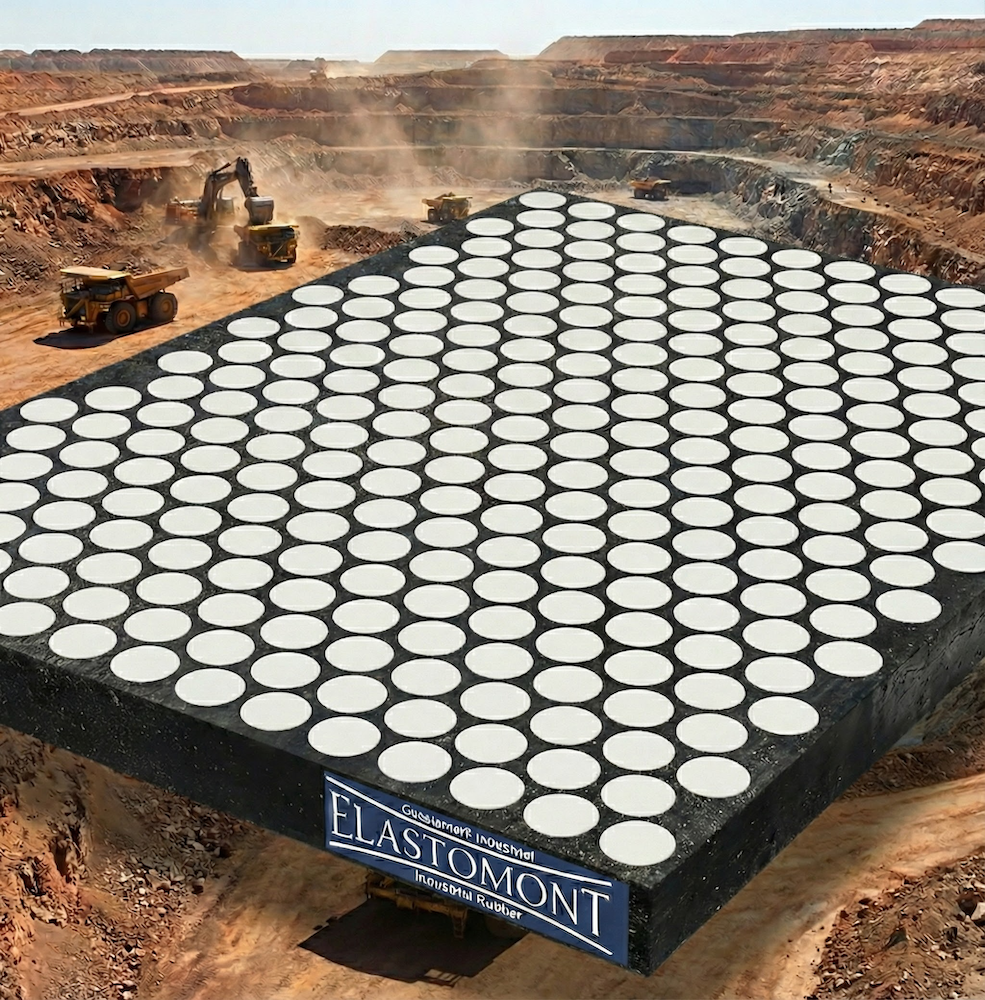
Rocks and gravel pouring from an industrial conveyor belt onto an ELASTOCER rubber ceramic wear liner. The panel features white ceramic cylinders embedded in a black rubber matrix, demonstrating high impact absorption and abrasion resistance in a mining environment.

Why Ceramic-Rubber Outperforms Wear Steel

  • Intelligent Shock Absorption (Rubber Matrix) The high-resilience rubber matrix acts as a cushion, decreasing peak stress at the moment of impact. This critical layer protects the ceramic edges from spalling, limits micro-cracking in the tiles, and preserves the structural integrity of the liner.
  • The Ultimate Anti-Abrasion Shield (Ceramic) Our 92% Alumina ceramic creates a "diamond-hard" surface that is ultra-resistant to the sliding and rolling wear caused by abrasive fines. It provides a wear life significantly superior to standard steel.
  • Corrosion & Rust Resistance On the flow side, the ceramic and rubber combination is chemically inert. This creates a waterproof barrier that protects the steel backing plate, effectively reducing the overall corrosion-erosion cycle.
  • Noise & Vibration Damping The elastomeric layer significantly dampens impact energy and vibrations. These liners are much quieter than steel plates, contributing to a safer work environment (HSE compliance).
  • Superior Durability vs. Hardened Steel In real-world service conditions combining both impact and abrasion, ELASTOCER consistently outperforms AR400/500 (Hardox®) plates in terms of longevity and operational comfort.

The Elastomont Specialty: 100% Focused on Rubber-Ceramic

  • Zonal Engineering We don't just supply sheets; we engineer by zone. We analyze your equipment to differentiate between reception/impact zones, sliding/velocity zones, and critical transitions to apply the right geometry.
  • "Maintenance-First" Paneling Our solutions are designed for the maintenance crew: modular panels that are individually replaceable. This allows for localized repairs and easy access to fasteners without replacing the entire chute lining.
  • Geometric Continuity & Flow Promotion We utilize engineered beveled tiles and tapered transitions to minimize gaps. This ensures smooth flow, drastically reduces material build-up (hang-up), and prevents rocks from snagging and tearing out the liner.
  • Local Manufacturing (Quebec) Benefit from fast lead times of 2–4 weeks. We manufacture complex shapes in-house, including angles, radii, diameters, and custom cutouts—no long waits for imports.

Technical Specifications, Formats & Materials

  • Panel Thicknesses Available from 1/2″ to 5″ (approx. 12.7mm to 127mm), selected based on the specific impact energy, material velocity, and required rigidity of the application.
  • Standard & Custom Sizes Standard stock sizes include 12″×12″, 16″×18″, 24″×24″, and 24″×48″. We also provide fully custom fabrication for angles, radii, diameters, and specific opening cutouts.
  • Ceramic Quality (Al₂O₃) We use 92% Alumina as our standard high-grade material, with a 94% Ultra-Wear option available for the most extreme applications.
  • Ceramic Geometries We stock Cylinders (for high impact) in all dimensions, as well as Cubes and Engineered Tiles for sliding wear applications.
  • Rubber Matrix Formulations Standard production uses a durable NR/SBR blend. Specialized formulations are available upon request for environments involving low pH, oils, solvents, or high temperatures.
  • Backing Plate Options Standard backing is Mild Steel (3/16″, 1/4″, or custom). We also offer Stainless Steel or Magnetic backing options.
  • Fastening Systems Versatile installation methods including Nelson Studs, Counterbored Bolting, and Spot/Plug-Welding. (Proprietary bondable/glue-on options are also available)

Installation Methods & Fastening Systems

ELASTOCER wear plates are designed for flexibility and can be installed using multiple methods to suit your specific equipment configuration:

  • Direct Bonding (Glue-On): For applications where mechanical fastening is not possible.
  • Welded Studs: Threaded studs welded to the steel backing (Blind Bolt) for a smooth wear face with no visible holes.
  • Molded Counterbored Holes: Pre-molded holes within the ceramic/rubber matrix to allow for secure through-bolting with rubber plugs.
  • Welding (Plug or Tack Weld): The steel backing allows for direct welding to the host structure.

This range of fastening options allows our solutions to be easily retrofitted onto all types of equipment, including conveyors, chutes, hoppers, and crushers, regardless of the existing structure.

Typical Applications

  • Minerai broyé primaire: Heavy impact zones handling large, jagged rocks immediately after primary crushing.
  • Abrasive Slurries & Thick Sludge: Wet processing environments where corrosion and fine particle abrasion are constant.
  • Fine Sand & Granular Materials: High-velocity sliding wear zones requiring smooth surfaces to prevent sticking.
  • Rotary Distributors: Complex geometries requiring custom-cut ceramic protection.
  • Discharge Chutes & Hoppers: Critical transfer points prone to both impact and sliding wear.
  • Crushers & Mills: Internal liners for rock boxes and feed points within comminution circuits.
  • Conveyor Skirting: Side liners (skirtboards) to contain material and prevent spillage on belts.
  • Feeder & Pan Liners: Protection for vibrating feeders and discharge pans.
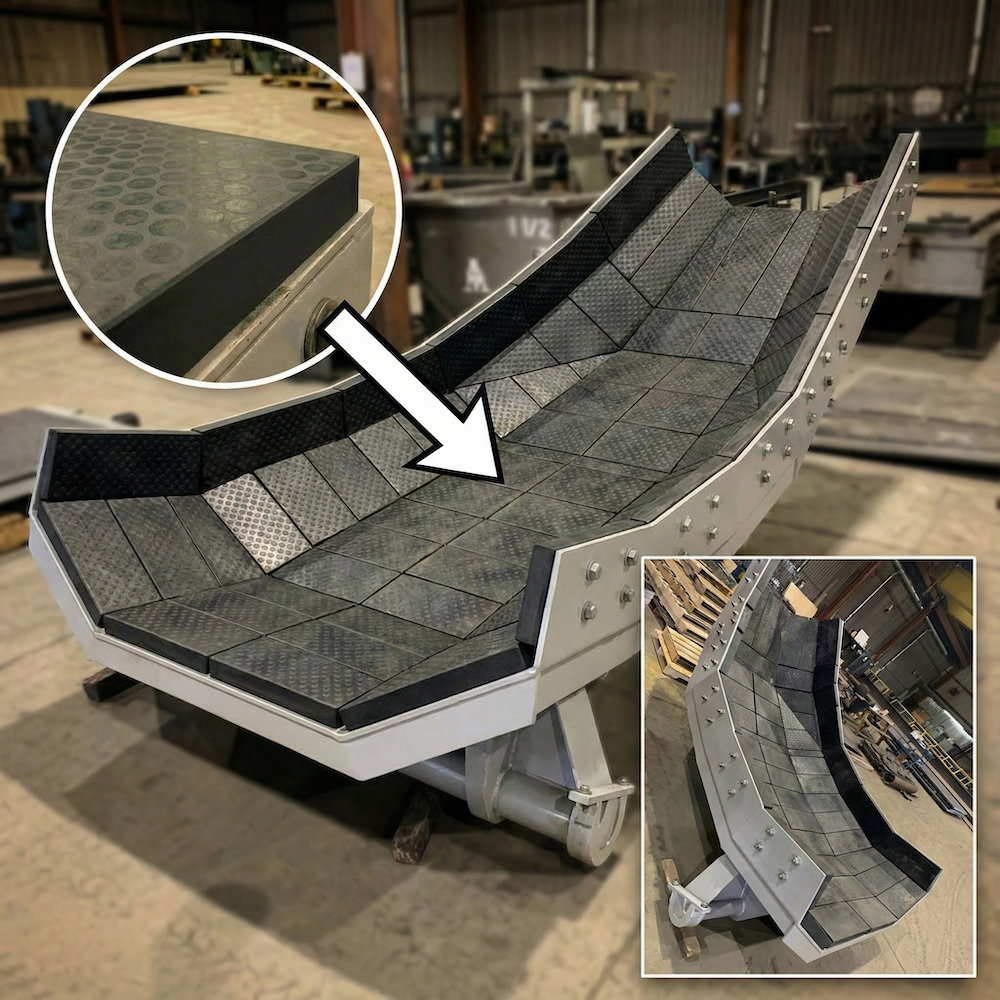
Ore conveyor deflector for loading dock with Elastomont Elastocer rubber-ceramic wear plates.

Quick Selection Guide: ELASTOCER Configuration

Application Context / Zone Impact Level Abrasion / Velocity Material State (Sticky/Wet) Recommended ELASTOCER Solution
Primary Impact / Drop Zone (Large Rocks) High Medium Dry / Wet Cylindrical Matrix or Beveled Tiles on Steel Backing.
High-Velocity Transfer Points (Fines) Low–Medium High Dry Engineered "Tapered" Tiles + Optimized Layout Pattern.
Restricted Access / Short Shutdowns Variable High N/A "Maintenance-First" Modular Panels (Individually replaceable).
Nozzles / Orifices / Discharge Points Localized High Variable Bolt-on Modules + Removable Sleeves (Custom fabricated).

Available Product Variants

FAQ: ELASTOCER Ceramic-Rubber Wear Liners

What are ELASTOCER wear plates and what are they used for? +
ELASTOCER is a premium composite wear liner consisting of high-grade 92% Alumina ceramic tiles hot-vulcanized into a shock-absorbing rubber matrix on a steel backing. They are used to protect industrial equipment (chutes, hoppers, transfer points) from extreme sliding abrasion and heavy impact, significantly extending equipment service life compared to standard steel.
Why choose ELASTOCER over AR Steel (Hardox®) plates? +
While AR Steel is hard, it cannot match the Mohs 9 hardness of ceramic for sliding wear resistance. ELASTOCER liners typically last 3x to 10x longer than AR400/500 steel in abrasive applications. Additionally, the rubber matrix dampens vibration, drastically reducing plant noise levels—something steel cannot do.
Where can I find a ceramic wear plate manufacturer near me in Quebec? +
Elastomont is a specialized manufacturer located in Quebec, serving Montreal, Eastern Canada, and North America. Because we manufacture locally rather than importing, we offer faster lead times (2-4 weeks) and direct engineering support for custom wear projects.
What specific types of ceramic and rubber are used? +
We use 92% Alumina Ceramic (standard) or 94% Ultra-Wear Ceramic for extreme applications. The ceramic is bonded into a High-Resilience Rubber matrix (NR/SBR blend) designed to absorb kinetic energy. The steel backing ensures structural rigidity and allows for welding or bolting.
What standard sizes and thicknesses are available? +
Our standard panel sizes include 12″×12″, 16″×18″, 24″×24″, and 24″×48″. Thicknesses range from 1/2″ up to 5″, depending on the impact energy. We also specialize in custom fabrication for unique shapes, cones, and transitions.
How are ELASTOCER wear plates installed? +
Installation is flexible to fit your setup. Options include:
  • Welded Studs: (Nelson studs) on the back for a smooth wear face.
  • Counterbored Holes: For through-bolting with rubber plugs.
  • Plug Welding: Welding the steel backing directly to the chute.
  • Magnetic Mounting: For quick-change applications without hot-work.
Can I replace just a section of the liner if only one spot is worn? +
Yes. This is a key advantage of our "Maintenance-First" modular design. You can replace individual panels in high-wear "hot spots" without needing to strip and re-line the entire chute, saving significant time and budget.
For which industrial applications is ELASTOCER best suited? +
ELASTOCER excels in environments involving Sliding Abrasion + Impact. Typical applications include:
  • Mining: Ore transfer chutes, rock boxes, screen decks.
  • Aggregates: Crushers, discharge hoppers.
  • Concrete: Mixers and sand washing plants.
What is the lead time for manufacturing and delivery? +
Thanks to our local manufacturing facility in Quebec, our standard lead time is 2 to 4 weeks for custom orders. We also keep stock of standard plates for immediate "Rush" delivery to minimize your downtime.
Do you provide wear lining services near me for on-site assessment? +
Yes. Our technical team covers the Quebec and Ontario regions for on-site wear analysis and laser measurements. For remote clients, we provide detailed engineering assessments via digital drawings to ensure the perfect fit.

Call us